Pickleball is carving out new spaces in Japan, with hotels, shopping centres, and sports academies setting up courts to attract customers and expand their reach.
The Shinagawa Prince Hotel in central Tokyo, for instance, opened an indoor pickleball court in late March, converting part of a banquet hall on the 10th floor of its main tower. The move is part of the hotel’s push to broaden entertainment offerings. “There aren’t many places where people can play pickleball inside a hotel. This will likely encourage players to stay with us,” a spokesperson said.
Rental fees run 8,000 yen for a 50‑minute weekday session and 11,000 yen during evenings and weekends. Paddles and shoes are available for rent, making it easy for guests—many of them international visitors from North America and Southeast Asia—to join in. To draw locals, the hotel is offering trial sessions, including women‑only and senior‑friendly programmes.
Pickleball’s rise in Japan has been rapid. As of March, the country had an estimated 330,000 players, more than seven times the number from a year earlier, according to Pickleball One. The sport’s accessibility has fuelled growth across all ages and genders.
In western Tokyo, Frespo Wakabadai shopping complex has added four indoor courts for a limited run through early May. Operated by Daiwa Lease, the courts have already drawn more than 1,000 players in just 19 days, ranging from beginners to intermediates. “We’ve seen more customers in sportswear around the complex, including the supermarket,” a Daiwa Lease representative noted, pointing to the synergy with other tenants. Noise complaints have been absent, thanks to the courts being placed next to an arcade.
Akihisa Kawamoto, president of Akika—the company running the courts—said demand is strong. “There’s a shortage of pickleball courts, so people come from far away to use these. Having them is helping to expand the commercial reach of the complex.” Akika plans to open more courts in suburban shopping centres.
Sports academies are also adapting. Takagi Kogyo, a tennis school operator, has started offering pickleball lessons during downtime at its Tokyo and Kanagawa locations. Tennis courts can be converted with marking tape and portable nets at relatively low cost—tens of thousands of yen per court. Takagi’s tennis coaches have earned pickleball instructor certification. “They can directly leverage their expertise as tennis coaches,” said Yasuhiro Nakajima, general manager.
At one Tokyo site in Koto ward, Takagi even repurposed a futsal field inside the same building to run a pickleball school. About 100 members have signed up, most of whom had never attended its tennis programmes.
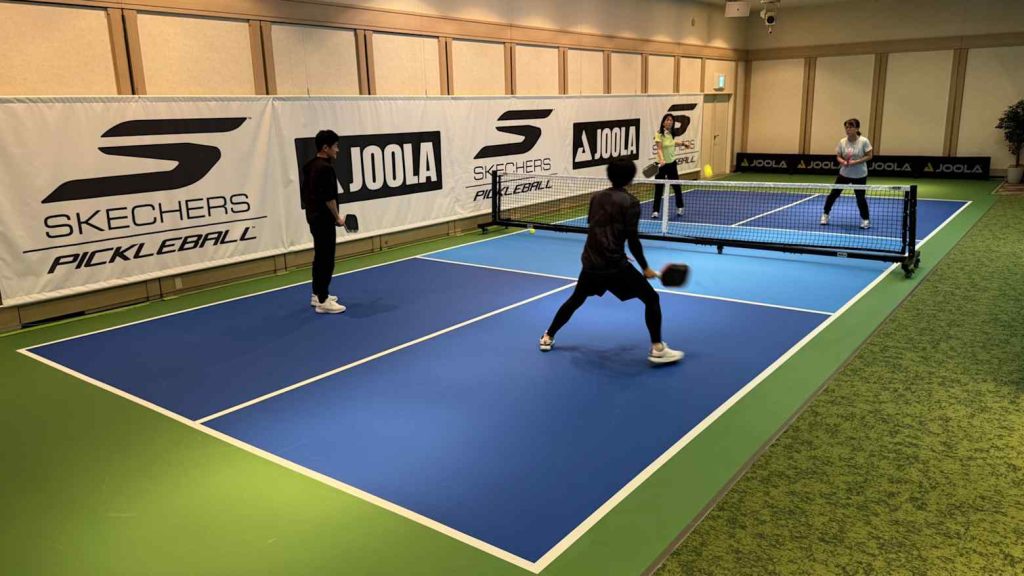
Perhaps unsurprisingly, the rapid expansion of pickleball facilities across Japan coincides with a major organisational milestone. The Japan Pickleball Association (JPA) and the Pickleball Japan Federation (PJF) have formally merged to create a single national governing body—Pickleball Japan. The merger, signed on 13 March 2026 and effective from 14 April 2026, removes the structural friction of having two separate organisations and provides a unified voice for the sport.
Now, with a single, unified governing body, all that’s left is to bring pickleball closer to the masses and expand the playing community. This goal is being made possible by the creation of new facilities all around the country.
Put simply, from hotels to shopping centres to sports academies, pickleball is finding new ground in Japan—bringing in fresh crowds, boosting businesses, and proving that the fastest‑growing sport in the world is gaining momentum in Tokyo and beyond.