Anyone who’s stood courtside at a busy open-play session knows the drill. Ten or twelve players waiting on a single court, a paddle stack that only sort of makes sense, and 30 or 40 minutes ticking by before you actually get to play. PickleQ, a browser-based platform for managing open-play sessions, was built specifically to fix that bottleneck—and the numbers suggest it’s found real demand for the fix.
The idea traces back to a problem its founders lived through from both directions. As newer players, they regularly found themselves in games with significant skill gaps. As they improved, they ran into the exact same issue from the other side of the mismatch. That experience left them with a fairly simple conclusion: running a good open-play session takes more than pulling the next four names off a list. It takes real attention to skill balance, waiting time, partner variety, and basic fairness—things a traditional paddle stack was never really built to track.
A Problem Southeast Asia Knows Too Well
The pain point is especially visible in the Philippines, where pickleball’s growth has outpaced the courts available to support it. During a busy Metro Manila session, it’s common for ten or twelve players to be stuck waiting on a single court for the better part of an hour. Paddle stacks can work in theory, but they rely heavily on whoever’s running the session that day—players get skipped by accident, the same groups end up playing each other repeatedly, and courts sit idle while someone tries to work out who’s next. The same problem persists in the Philippines’ Southeast Asian neighbours, from Malaysia to Vietnam and, to a lesser extent, as far away as Thailand and Indonesia.
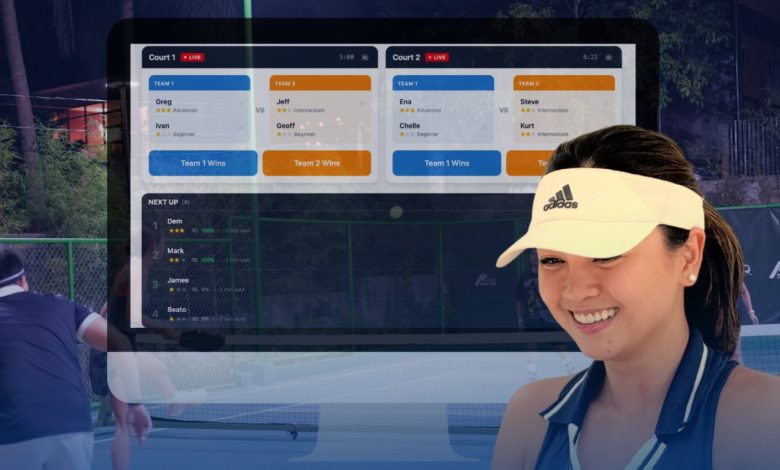
PickleQ folds the entire session into one platform instead of leaning on a spreadsheet and a clipboard. Organisers can set up a session, add players and available courts, form matches, log scores, and manage rotations from a single dashboard. Players, for their part, check in through a reusable QR code or a shared kiosk and can follow the queue, see upcoming matches and court assignments, and track standings straight from their phones.
Much of that functionality wasn’t dreamed up in isolation—features like locked partners, dedicated skill courts, and safeguards against drawing the same opponent repeatedly all came directly from feedback by organizers actually running open plays. Since launching in January 2026, the platform has been used to create more than 16,000 clubs, completing over 107,000 sessions, representing more than 1.5 million player appearances and nearly two million games. PickleQ can’t conjure up additional courts out of thin air, but it can help organisers squeeze more efficient use out of the ones they already have.
Closing the Gap With DUPR
The platform’s founders also noticed a separate but related headache once they got more involved in competitive pickleball: reporting results to DUPR. At rated sessions, players would often scribble their DUPR IDs on paper while staff manually entered scores afterward—a process that could take days to show up in the system and left plenty of room for wrong scores, reversed winners, or results attached to the wrong players entirely. None of that was DUPR’s fault. It was simply friction in the manual handoff between what happened on court and what eventually got submitted.
PickleQ’s answer is DUPR Mode, part of its paid Venue Pro toolkit. It lets organisers collect DUPR IDs alongside the session roster, record winners and scores the moment a match ends, keep everything tied to the correct session, and generate a DUPR-ready bulk export in the platform’s current 27-column format. So far, organisers have logged more than 23,000 games through DUPR Mode and generated over 550 DUPR-ready exports covering more than 22,000 matches.
Treating Rotation as a Real Problem to Solve
What separates PickleQ from a simple digital version of a paddle stack is how seriously it treats the actual matchmaking. The platform factors in skill balance, waiting time, partner and opponent variety, locked partnerships, court availability, and fairness for players near the front of the queue—and it puts a hard cap on how long anyone waits, moving a player to the front after two skipped rotations rather than leaving that judgment call to chance.
Every proposed change to the matchmaking logic gets tested against simulated games before it ever reaches the live platform. If an update produces better-balanced matches but creates longer waits or uneven participation elsewhere, it doesn’t ship. In repeated tests of a busy five-court scenario, courts stayed active roughly 95 percent of the time, and every player logged at least three games—evidence, the team argues, that open-play rotation is genuinely an optimisation problem rather than a simple scheduling convenience.
For organisers juggling a full open-play calendar and for players just hoping to get a fair shake at court time, that distinction is doing a lot of the platform’s actual work.