You have invested in a better paddle. You have worked on your third-shot drop. You have taken lessons, watched footage, drilled your dinking until your arm complained. And yet something is still missing—a sharpness you cannot quite locate, a reaction time that feels a half-step behind, a mental fog that settles in around the third game of a long session.
The answer might not be on the court at all. It might be in your bedroom.
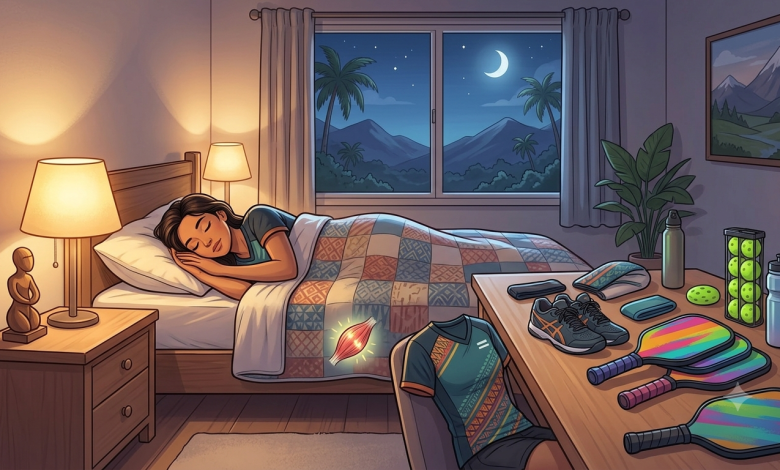
Sleep is the most underrated performance tool available to pickleball players at every level—and it is the one that costs nothing, requires no equipment, and delivers benefits that no amount of drilling can fully replicate. Yet most recreational and competitive players treat it as an afterthought, squeezing it around early-morning court bookings, late-night tournaments, and the general busyness of adult life. That is a mistake, and the science makes clear exactly why.
What Happens to Your Brain Without Enough Sleep
Pickleball is, at its core, a decision-making sport. Every rally demands split-second choices—whether to speed up or reset, where to place the ball, when to poach, how to read your opponent’s paddle angle. Those decisions happen faster than conscious thought, which means they depend almost entirely on the quality of your neural processing.
Sleep is when the brain consolidates the skills and patterns learned during waking hours. Research published in the journal Nature identified a process called memory consolidation during non-REM sleep, during which the brain replays and strengthens motor sequences practiced during the day. If you work on your backhand roll in a morning session and then sleep well that night, your brain actually continues practicing that movement while you rest—encoding it more deeply into procedural memory than practice alone would achieve.
Deprive yourself of that consolidation window, and the opposite happens. A landmark study from the University of Pennsylvania showed that even modest sleep restriction—six hours a night over two weeks—produced cognitive impairment equivalent to going 24 hours without sleep. Reaction time, spatial awareness, decision quality, and sustained attention all degraded significantly. The subjects in that study, notably, did not feel as impaired as they were. Sleep deprivation distorts your perception of your own performance.
Put simply: you may think you are playing well on five or six hours of sleep. You almost certainly are not.
Reaction Time Is Not Optional
In pickleball, the distance between the kitchen line and your opponent is about 14 feet. At the speed of a hard-driven ball, you have somewhere between 180 and 230 milliseconds to respond—roughly the time it takes to blink twice. Reaction time at that margin is not a luxury. It is survival.
Sleep research at the Stanford Sleep Disorders Clinic found that athletes who extended their sleep to nine or more hours per night—as part of a structured sleep extension protocol—showed significant improvements in reaction time, sprint speed, and accuracy. The research was originally conducted on basketball players, but the underlying mechanism applies to any sport demanding fine motor control and fast reflexes.
A 2021 meta-analysis published in the British Journal of Sports Medicine reviewed 69 studies on sleep and athletic performance, finding consistent evidence that sleep extension improves reaction time across sports. The effect was most pronounced in sports requiring hand-eye coordination and rapid decision-making—exactly the demands that define competitive pickleball.
The Recovery Question
Pickleball is physically demanding in ways that casual players often underestimate. Lateral movement, explosive starts and stops, shoulder rotation through hundreds of strokes, and the low-to-high kinetic chain demands of groundstrokes—these all accumulate into genuine musculoskeletal stress over a session or a tournament day.
Sleep is when the body repairs that stress. Human growth hormone—the primary driver of tissue repair and muscle recovery—is released almost exclusively during deep sleep, specifically during slow-wave sleep in the early part of the night. Cortisol, the stress hormone that breaks down muscle tissue, drops during sleep and rises again when you wake. Disturb that cycle and the repair process is interrupted—leaving muscles more fatigued at the start of your next session than they should be.
For older players—and pickleball’s demographic skews significantly toward the 40-plus bracket—this recovery function becomes even more critical. The body’s natural recovery capacity declines with age. Sleep is one of the few levers that can partially compensate for that decline. Players in their 50s and 60s who prioritise sleep are not merely feeling better. They are genuinely recovering faster, reducing injury risk, and sustaining performance across longer competitive arcs.
The Mental Game Sleeps Too
There is a psychological dimension to sleep deprivation that pickleball players rarely account for. The prefrontal cortex—the brain region governing impulse control, emotional regulation, and strategic thinking—is among the most sleep-sensitive structures in the brain. When it is underrested, the result is not just slower thinking. It is worse decision-making under pressure, lower frustration tolerance, and a reduced capacity to adapt strategy mid-match.
If you have ever noticed yourself making unforced errors late in a match, losing patience with a reset game you know you should be playing, or making the same tactical mistake repeatedly despite being aware of it—sleep deprivation may be contributing more than you realise. Research from Harvard Medical School found that sleep-restricted individuals showed significantly impaired performance on tasks requiring flexible thinking and the ability to override habitual responses. In pickleball terms: that is the difference between adjusting to what your opponent is doing and continuing to do what is comfortable even when it is not working.
What Good Sleep Actually Looks Like
The National Sleep Foundation recommends seven to nine hours for adults, with athletes at the higher end of that range during periods of intensive training or competition. Quality matters as much as quantity. Sleep hygiene—consistent bedtimes and wake times, a cool and dark sleeping environment, limited screen exposure in the hour before bed, and avoiding alcohol within three hours of sleep—significantly affects the depth and restorative quality of rest.
Tournament players in particular should treat the night before competition the same way they treat pre-match nutrition: deliberately and without compromise. A well-rested player arriving at a morning draw will outperform their sleep-deprived counterpart at the same skill level. The margin may be invisible on the scoresheet for the first game. By the third game of a long day, it tends to show.
The Bottom Line
The pickleball community talks endlessly about paddles, technique, footwork, and strategy. Sleep gets almost none of that attention—despite being the one variable that affects all the others simultaneously.
Better reaction time. Faster skill consolidation. Deeper muscle recovery. Sharper decision-making under pressure. Greater emotional regulation in long matches. All of it flows from the same source. All of it is available to any player willing to take their rest as seriously as their game.
The hidden weapon in your pickleball arsenal is the one you deploy every night with your eyes closed. Start using it better.