Every pickleball paddle is on borrowed time from the moment it leaves the shop. That’s not a design flaw—it’s physics and the natural law of the world. You use the paddle over and over, it breaks down. What varies wildly is how much time you actually get out of it, and that gap has far less to do with the paddle itself than most players assume.
Play casually and a decent pickleball paddle can last you years. Get through three to five sessions a week and you’re generally looking at somewhere between six and eighteen months of genuine peak performance. Play daily with real power behind your swings and you’ll wear through one faster than either of those groups. None of that is fixed, though. The habits you keep between sessions can stretch or shrink those numbers considerably, and here’s how to make sure they’re working in your favour.
1. Understand Why a Pickleball Paddle Wears Out at All
Every single strike between ball and face sends a jolt of energy straight into the core, whether that core is built from honeycomb polymer or engineered foam. Do that thousands of times and the internal structure slowly compresses, the rebound softens, dead spots creep in, and the sweet spot you once trusted starts shrinking. That process is entirely normal. It happens to every paddle ever made, and there’s no avoiding it.
What isn’t normal—and what’s entirely avoidable—is speeding that process up through carelessness. Heat, moisture, hard-surface knocks, and sloppy storage can strip months off a paddle’s useful life without you ever noticing until performance suddenly drops off. The real difference between a paddle that’s still sharp at eighteen months and one that’s already fading at eight usually comes down to habits, not manufacturing.
2. Keep Heat Away From Your Paddle
Heat does more damage to a paddle’s lifespan than almost anything else, and it’s the threat most players never think twice about. Leave a paddle sitting in a car on a hot afternoon and interior temperatures can climb past 140°F—hot enough to soften the adhesive holding the face sheets to the core, and potentially warp the core material itself. Thermoformed paddles are particularly vulnerable here, given they were originally shaped under heat and pressure in the first place.
The fix costs nothing: keep your paddle indoors, in a space with a stable temperature. Not the boot of the car. Not the garage. Not propped against a sunny windowsill. If you’ve been playing outdoors in the heat, bring the paddle back inside as soon as you’re done rather than leaving it in the bag. Cold deserves attention too — prolonged freezing temperatures make composite materials brittle and considerably more prone to micro-cracking the next time you strike the ball.
3. Don’t Underestimate a Simple Cover
A cover won’t do anything to slow the internal wear that builds up through actual gameplay — nothing prevents that. What it does protect is everything around the edges: the scratches, dings, and general abrasion that build up during transport and storage. On a raw carbon fibre face, where that slightly gritty texture is what actually generates your spin, protecting the surface when you’re not playing is effectively protecting your spin game itself. Think of it the same way you’d think of a phone case — it isn’t going to stop the software ageing, but it’ll stop the screen cracking in your bag.
4. Wipe It Down After Every Session
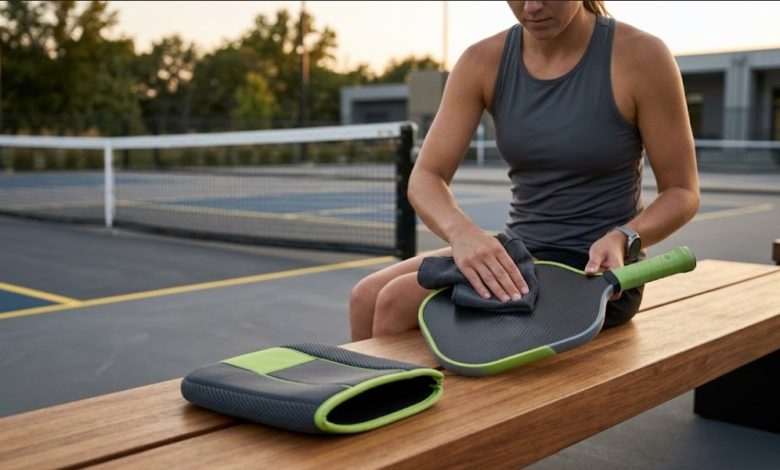
Dirt, ball residue, and general court grime build up on the face after every match, and that layer quietly eats into the surface friction responsible for your grip and spin. A quick pass with a microfibre cloth after play is enough to keep performance consistent session to session.
For a deeper clean, a dedicated paddle cleaning spray does the job properly—spray it on, wipe it off, done. Paddles with a raw carbon fibre face benefit from a specialised cleaning block, which lifts embedded debris without wearing down the texture that generates spin. Whatever you do, steer clear of household cleaners, solvents, or anything abrasive. They can strip the surface treatment entirely or leave behind residue that changes how the ball actually reacts against the face—the opposite of what you’re trying to achieve.
5. Treat It Like the Engineering It Actually Is
Modern paddles are built to handle reaction speeds comparable to a tennis racket, using composite sandwich construction not far removed from aerospace engineering. It’s easy to forget that when it’s sitting in your bag, but it’s worth remembering the next time you’re tempted to leave it baking on a car seat. A little discipline in how you store, cover, and clean your paddle won’t stop the clock entirely—nothing can, actually—but it will buy you considerably more months of it actually playing the way it’s meant to.