
Vietnamese Community in Laos Turns to Pickleball to Mark Important National Holidays

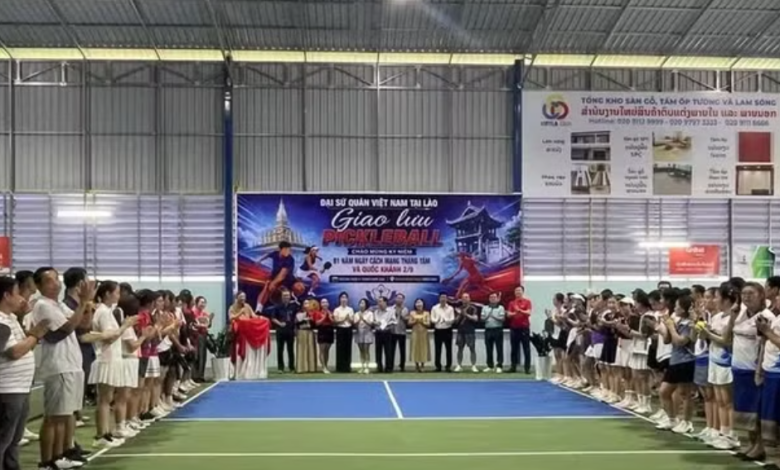
Some communities mark a national holiday with a formal ceremony and a quiet dinner afterwards. The Vietnamese community in Laos marked theirs with something rather livelier: a pickleball competition in Vientiane 13 teams and 86 players strong, all gathered on a single court-side afternoon in a country that isn’t their own.
The event, held on 21 August 2026, was organised by the Vietnamese Embassy in Laos alongside Vietnamese representative agencies and the wider community, timed to honour the 81st anniversary of the August Revolution and the approaching National Day on 2 September. It’s the kind of occasion that could easily have stayed formal and solemn. Instead, it turned into something that looked a great deal more like a community reunion than a state commemoration.
Sport as the Connector
That’s really the quiet genius of choosing a sport like pickleball for an occasion like this. Embassy staff, business representatives, and everyday members of the Vietnamese community in Laos don’t necessarily cross paths often in daily life—different jobs, different routines, different corners of the same city. Put a paddle in everyone’s hand and a net between the teams, though, and suddenly ambassadors, entrepreneurs, and ordinary community members are all playing the same game on the same afternoon, with nothing separating them but the score.
Thirteen teams representing a genuine cross-section of Vietnamese agencies, businesses, and community organisations in Laos took part, which says something about how far the idea travelled once it left the planning stage. This wasn’t a small gathering dressed up as a big one. It was a proper turnout, built entirely around the idea that shared identity is easier to feel on a court than in a meeting room.
More Than a Game
Ambassador Nguyen Minh Tam used the opening ceremony to place the day in its proper historical context, pointing to the August Revolution of 1945 and the founding of the Democratic Republic of Viet Nam on 2 September of that same year as the events that ushered in an era of independence—the foundation, as he put it, for everything Vietnam has built since. He spoke too of gratitude toward the generations who sacrificed for that independence, framing the celebration as a moment for reflection as much as for competition.
But it was his point about distance that landed closest to what the pickleball courts themselves were actually doing that day. For Vietnamese people living, working, and studying in Laos, Tam said, national holidays serve as a reminder that home isn’t a place you leave behind so much as one you carry a continued responsibility toward—a thread of solidarity that holds regardless of how many borders separate you from it. He also pointed to the broader role communities like this one play in strengthening the friendship between Vietnam and Laos more generally, two nations whose ties run through exactly the kind of everyday human connection a pickleball afternoon quietly represents.
It’s easy to overlook how much community-building actually happens over something as simple as a shared game. Eighty-six people showed up in Vientiane not just to compete, but to be reminded—through rallies, laughter, and a shared afternoon on the court—that distance from home doesn’t have to mean distance from each other.



One Comment