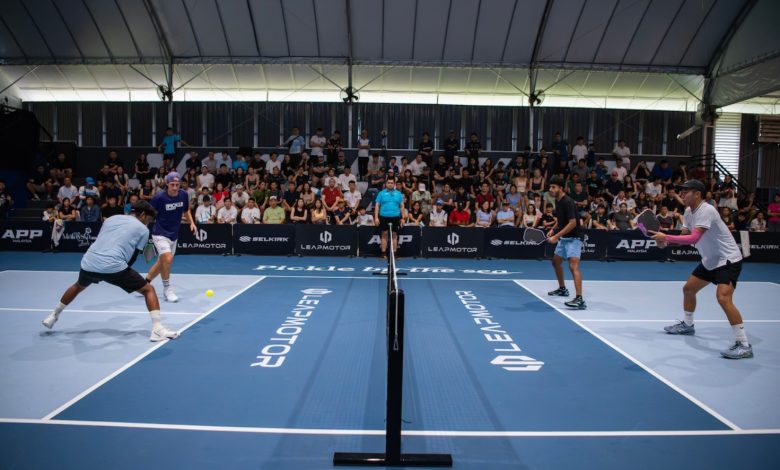
Kuala Lumpur and Penang were meant to be a test. Instead, they turned into a genuine proof of concept—and the four executives steering the APP Asia Tour haven’t had much chance to catch their breath since.
The numbers alone explain why. February’s Leapmotor APP Kuala Lumpur Open drew 1,760 player participations from 28 countries, 711 of them international entries. July’s Leapmotor APP Asia Penang Open followed with 1,386 participations from 22 countries and more than 100 competitors across the professional divisions. For a tour launched this year with the ambition of becoming a genuine regional circuit rather than a loose collection of one-off events, that’s about as strong a start as anyone could reasonably have hoped for.
Marc Chua, Yui See Lau, Caryn Yap and Yuki Chen—the leadership group behind APP Asia—are candid about what came next: straight back to work. “There has not been much time to stop,” Chua admits, “but it has been rewarding to look back and see how much we have managed to build in a relatively short period.” Chen puts it more bluntly still. “We are not catching our breath; we are building the platform.” The real task now, as she frames it, is turning two successful events into a repeatable operating system—consistent rules, officiating, rankings, data, player services and local partnerships that can travel across an entire region rather than sit within one country’s borders.
Making an American Brand Feel Local
Part of what made Malaysia work, according to the group, was resisting the temptation to simply transplant an American product wholesale. Chua points to Kuala Lumpur as the APP’s actual first entrance into Asia, a market where plenty of players had already followed the brand online without ever experiencing it in person. “Suddenly, something they had previously watched online from the other side of the world was happening on their own doorstep,” he says.
Lau saw the same shift up close. “There is a huge difference between following professional pickleball on Instagram or YouTube and suddenly having those players standing on the court next to you,” she says, describing an emotional connection that simply can’t be replicated through a screen.
For Yap, the differentiator wasn’t the competition itself but what happens around it. Rather than focusing purely on smooth tournament operations, her team has leaned hard into off-court activations designed to keep players engaged between matches — she’s even built a social tournament format that deliberately breaks from pickleball’s usual rules, teasing more to come across Asia.
That balance between international polish and local identity runs through everything the group says about the tour’s early success. “The goal is not to export American pickleball,” Chen explains. “The goal is to co-create a multi-polar global sport.” Lau echoes the same idea from a slightly different angle: “We are not trying to make every country look like the United States. We are trying to create an international sport in which every market can contribute something culturally and athletically unique.”
A Region That Refuses to Be One Market
If there’s a single lesson the group keeps returning to, it’s that “Asian pickleball” isn’t really one story at all. Malaysia has built a genuinely enormous participation base alongside rapidly developing infrastructure. Vietnam is producing serious competitive talent. China carries enormous long-term scale potential thanks to its size and existing racket-sport culture. India brings extraordinary youth numbers. Thailand, Taiwan, the Philippines and Indonesia are each developing along their own distinct paths.
Yap offers a useful note of caution alongside the optimism, pointing to Vietnam as a market that may already be approaching a maturity plateau among tournament-goers, where players increasingly weigh ticket prices against prize money before deciding whether an event is worth attending. Chen frames the broader challenge similarly — the bottleneck facing Asian pickleball isn’t interest, she argues, but governance, officiating, facilities and sustainable commercial models catching up with the enthusiasm already in place.
That diversity, rather than being a complication to smooth over, is treated by the group as one of the region’s genuine strengths. A badminton convert brings different instincts to the court than a former tennis player; a table tennis background shapes how someone reads angles and hand speed entirely differently again. “Rather than trying to make every market develop in exactly the same way,” Chua says, “our job is to create a common competitive platform that connects them.”
Why Racket Sports Take Root So Easily in Asia
The group is unanimous on why pickleball has found such fertile ground across the region: it’s building on decades of existing racket-sport culture. Badminton and table tennis already carry enormous participation and fan bases across Asia, and tennis holds its own established following too, meaning much of pickleball’s basic logic already feels familiar to newcomers.
What sets it apart, though, is how quickly that familiarity turns into genuine enjoyment. “You can give someone a paddle and have that person playing and having fun almost immediately,” Lau says, describing a sport with a low barrier to entry but a strikingly high competitive ceiling once players start digging into strategy, positioning and shot selection. Yap frames the appeal in even more personal terms, pointing to families spanning three generations, from grandparents in their sixties and seventies to children as young as ten, sharing a court together. “How can any other sport beat that?” she asks.
The Players Carrying Asia’s Next Wave
Ask the group who’s actually worth watching, and Vietnam dominates the conversation. Yap singles out Phuc Huynh specifically, calling his agility and accuracy in ball placement among the most impressive she’s ever witnessed. Chua adds Ly Hoang Nam, Trinh Linh Giang and Quang Duong to that Vietnamese contingent, alongside Taiwan’s Kao Pei Chuan, Hong Kong’s Kara Lin-Wheatley, and Vivian Glozman, who carries Taiwanese roots of her own.
Lau, while acknowledging that list, is more animated by what’s still to come. With such a vast pool of athletes across Asia already trained in badminton, tennis, table tennis and squash, she expects plenty more to make the switch to pickleball and progress quickly, particularly once a proper junior development pathway matures beneath them. Chen shares that focus on infrastructure over individual names, pointing to academies, referee pipelines and international exposure as the actual building blocks that will eventually turn participants into genuine global stars.
Building a Sport With Traffic Moving Both Ways
Underneath all of it sits a bigger ambition than simply running successful tournaments. Chua argues that pickleball can’t call itself a truly global sport while its strongest competitive infrastructure remains concentrated in North America. The goal of APP Asia, in his words, is bringing that same infrastructure—international-standard events, meaningful rankings, real prize money, broadcast exposure—directly to players who shouldn’t have to cross the Pacific just to access it.
Lau takes that vision a step further, arguing that a sport only becomes genuinely global once athletes can build actual careers in multiple regions, fans have local stars worth following, and sponsors see real opportunity in markets beyond the sport’s country of origin. Chua wants that traffic moving in both directions—American and European professionals competing in Asia, and Asian players becoming recognisable names within the wider global circuit.
Chen sums up the ambition perhaps most succinctly of all: APP Asia isn’t a satellite operation feeding off North America’s tour. It’s meant to be a second pillar entirely. Lau puts a human face on the same idea. “I want a young player in Asia to be able to look at pickleball and say, ‘I can become a professional without having to move to the United States,'” she says. If that vision holds, she believes the conversation in a decade’s time won’t be about “Asian pickleball” as some emerging offshoot of the sport at all. People will simply be talking about pickleball — with Asia sitting at the centre of some of its biggest stories.