Every pickleball federation on the planet wants the same line on its résumé: Olympic sport. Far fewer have asked the sharper question of what the realistic first step looks like.
Padel just answered it. From 28 September to 3 October 2026, the sport made its Asian Games debut at the Nagoya City Higashi Sports Center, with the first continental medals in its history up for grabs. Pickleball, with a larger Asian following than most sports its age could dream of, watched from the sidelines. That should sting. It should also be a blueprint.
How Padel Got Through the Door
Padel’s route wasn’t magic. It was method.
The Olympic Council of Asia recognised the International Padel Federation in November 2025 and included the sport on the Aichi-Nagoya programme. The decision followed a meeting at OCA headquarters in Kuwait between FIP president Luigi Carraro and OCA director general Husain Al Musallam. Carraro said the OCA “unanimously decided to recognise” padel as an official Asian Games sport. Al Musallam framed the move as embracing emerging sports that inspire “a new generation of athletes and fans.”
Notice what happened there. One international federation. One continental body, Padel Asia, pushing a cohesive roadmap. One clear ask. By March, the FIP had signed a memorandum of understanding with the Games organising committee and the OCA, and padel was confirmed as a medal sport. From recognition to first serve took roughly ten months.
Padel had also been quietly building a multi-continent résumé, having featured at the Mediterranean Games and the South American Games, with the European Games in 2027 to follow. The OCA itself called padel’s Asian Games inclusion a major step toward global recognition, “paving the way” for potential Olympic inclusion. Potential being the operative word. But as steppingstones go, it is a sturdy one.
Asia Is Pickleball’s Strongest Argument
Pickleball can make this case from a position of strength.
DUPR’s latest growth figures show the Philippines up 1,213 percent, Indonesia up 405 percent, and China up 183 percent. Xinhua reports about 8 million people playing in China, while Vietnam is said to have more than 10 million. The Heineken Pickleball World Cup in Da Nang drew athletes registered from 78 countries and territories, earning a Guinness World Record. Demand isn’t the issue.
What’s missing is the campaign. The Asian Pickleball Association has listed it as Goal 1 on its own website: attain official OCA recognition, “paving the way for its inclusion in the prestigious Asian Games.” The ambition is already written down. Someone has to turn it into a lobbying effort.
The Legitimacy Dividend
Here’s why the Asian Games should come before the Olympic push, not after.
The Global Pickleball Federation’s own FAQ lays out what the IOC wants to see: one recognised international federation per sport, national federations recognised by their ministry of sport or National Olympic Committee, a global competition calendar, and universality, benchmarked at 75 national federations for men and 40 for women. The AIMS route requires at least 60 national federations across three continents.
An Asian Games bid forces pickleball to build much of that machinery. Athletes compete through National Olympic Committees, which means federations must earn recognition from them. A medal event creates a credible multi-nation calendar. And a sport that competes in front of dozens of National Olympic Committees generates exactly the universality evidence the IOC weighs.
It also changes the nature of the pitch. An Olympic bid from a sport that has never been tested at a multi-sport Games is a proposal. An Olympic bid from a sport with an Asian Games medal table is a track record.
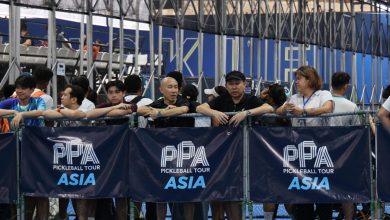
Of coruse, none of this guarantees a thing. The GPF itself says unification does not guarantee Olympic entry, and the IOC makes its own call. The OCA also recognised a single governing body for padel, while pickleball remains split among rival international federations. That’s the hard part, and the Asian push would force the issue, which is rather the point. There are encouraging signs, with the APP Asia Tour, for example, sanctioned by both the Asian Pickleball Association and the Asia Federation of Pickleball.
Time matters too. Doha is next, followed by Riyadh. The window to lobby is open now.
What Asia’s Stakeholders Should Do
Put simply, they must speak with one voice. They need to pick a single recognised body and approach the OCA together. Get national federations recognised by their National Olympic Committees and sports ministries. In the Philippines, that means the Philippine Pickleball Federation, the POC, and the PSC should be at the front of the queue, given a growth rate that tops the world. Then stage the continental events that prove the case.
Padel didn’t wait for the Olympics to validate it. It went to the Asian Games first. Pickleball, with all of Asia already swinging, has no excuse to wait.