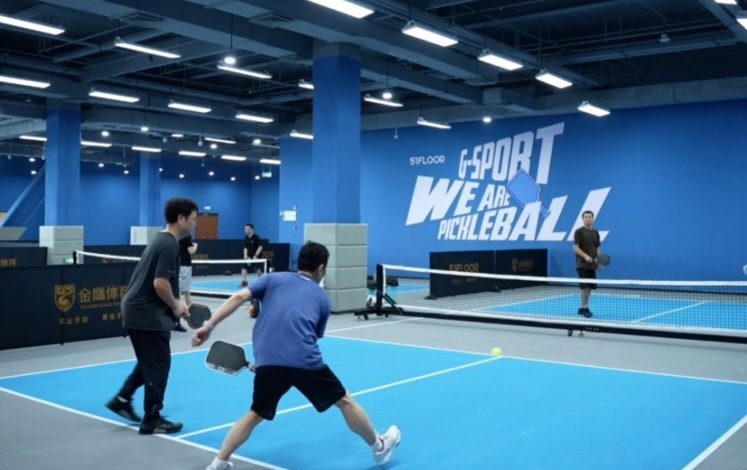
Pickleball courts are no longer confined to conventional sports centres. In China, for instance, one venue has taken the game to the 51st floor of a commercial building, offering a glimpse of how the sport is becoming part of a much bigger urban recreation and consumer lifestyle.
At the Golden Eagle World building in Nanjing, players can now trade shots high above the city at a sports complex spanning approximately 12,000 square metres. The facility began trial operations on 30 May 2026 and features 11 international-standard pickleball courts, alongside an indoor golf zone and a fitness and rehabilitation centre.
But the appeal goes beyond having an unusual place to play.
As evening sets in, the courts remain busy with players squeezing in games after work. Friends meet, compete and socialise before heading downstairs for dinner or shopping. The venue, according to a special report by VN Express International, effectively turns a pickleball session into part of a wider outing, connecting sport with dining, retail and leisure.
Pickleball Is Helping China’s Urban Recreation Scene Thrive
That combination is becoming increasingly important to China’s urban recreation scene. Sports facilities are finding space in commercial developments and unconventional locations, while operators look beyond court bookings and memberships to create experiences that keep visitors engaged for longer.
For pickleball, the opportunity is particularly interesting. Its social and accessible format makes it a natural fit for venues that want to attract groups rather than individual customers. A court can bring people together, but the businesses around it can also benefit from the traffic.
The Nanjing complex illustrates how that model can work. Players come for pickleball, but their spending does not necessarily stop when the match ends. Food, shopping and other recreational activities become part of the same visit.
A Seismic Shift in How Consumers Consume Sports
This shift also reflects changing expectations among consumers. Exercise remains a key reason to participate, but people increasingly value the social interaction and experiences that come with it. Pickleball, in that sense, is not simply competing for space alongside other fitness activities. It is becoming part of how people spend their leisure time.
The wider commercial potential of sports is already evident in China’s major cities. Shanghai’s sports-related consumption exceeded 100 billion yuan in 2025, supported by flagship events such as the Formula 1 Chinese Grand Prix, the ATP Shanghai Masters and the Shanghai Marathon. While those events operate on a different scale, they demonstrate how sport can generate spending well beyond the competition itself. To this end, look back at our previous report about the Baguio Country Club in the Philippines opening pickleball courts, or how the Kandooma in Maldives has added a court of its own, or how malls like The Whampoa in Hong Kong are opening pickleball facilities right inside.
That being said, pickleball’s contribution to this expanding market will depend on more than the number of courts built. Venues must give players reasons to return, while creating opportunities for businesses around them to benefit from participation.
Nanjing’s 51st-floor complex offers one approach. It places pickleball in an environment where sport, socialising and consumption overlap. And as more Chinese cities rethink how they use urban spaces, the game could find itself playing an increasingly visible role in that mix.
The bigger question is no longer just where people can play pickleball. It is what else a pickleball venue can bring to the table.