
Weeding Out the Buayas: A Deep Dive into Malaysia’s DUPR Sandbagging Problem and How It Is Eroding Trust in Pickleball Tournaments

Imagine joining a tournament that you believe has been organized for players at your skill level (e.g. specifically for intermediate level). You register, you pay the joining fee, and you train. You hope for the best. You go out there, play your very best, hoping to get to the podium.
But the dream ends because you get outclassed by someone who looks way better than the tournament’s skill level requirement. You give that player the benefit of the doubt, only to see that same player turn up again and again at lower skill level tournaments continually walking away with golds and podiums.
You ask yourself, how is it that despite all these wins, these players have not progressed to a higher-level category and are still able to qualify for lower skill level tournaments?
If you’ve been around the sport long enough, you know what sandbagging is already. It refers to the deliberate manipulation or suppression of one’s DUPR rating in order to qualify for tournaments with rating caps. By entering lower-rated divisions, a player gains a competitive advantage over opponents who are genuinely rated at that level, often increasing their chances of winning matches, titles, and prize money.
The problem is that across the tournament playing community, players know who these Buayas are, and quietly complain amongst themselves when they see their names in yet another beginner’s tournament, but no-one seems prepared to call them out. Tournament organisers are aware and frustrated, but sometimes unsure how to handle the problem, and other players silently suffers
So PNA decided to look into this further and assess whether this is really happening. We selected some names that kept on cropping up in the “eco-system” chatter as “Buayas” to see if the stats backed up the rumors.
We should state that what follows is an analysis of some player’s tournament performance combined with a review of their DUPR ratings. PNA is not making a judgement on whether these specific players are intentionally cheating, we are only presenting the data to allow readers to draw their own conclusions.
After careful consideration PNA has elected NOT to name the players because we felt we couldn’t justify only naming three when there are so many others that exhibit the same actions which in our view look like DUPR manipulation. It would not have been fair to single out and name just three.
However, we do hope these players read this article and if our suspicions are correct, that they realise that their actions are not going unnoticed.
Example 1 – 32-Year-Old Female from Petaling Jaya
This lady usually plays mixed doubles and her name was mentioned in several discussions that PNA conducted with players, tournament officials, and tournament organisers. These discussions raised questions within the community about rating patterns and tournament performance.
PNA is not alleging that this player has engaged in cheating, misconduct, or intentional manipulation of DUPR ratings. Our review is limited to examining publicly available DUPR data and comparing it with tournament outcomes to determine whether the community speculation surrounding the term “buaya” has any observable basis.
Any observations made here reflect analysis and commentary, not factual conclusions about Player Name’s intentions or integrity.
A review of her results on Sportsync and her DUPR play reveals what in our opinion is pattern which could be interpreted as manipulation.
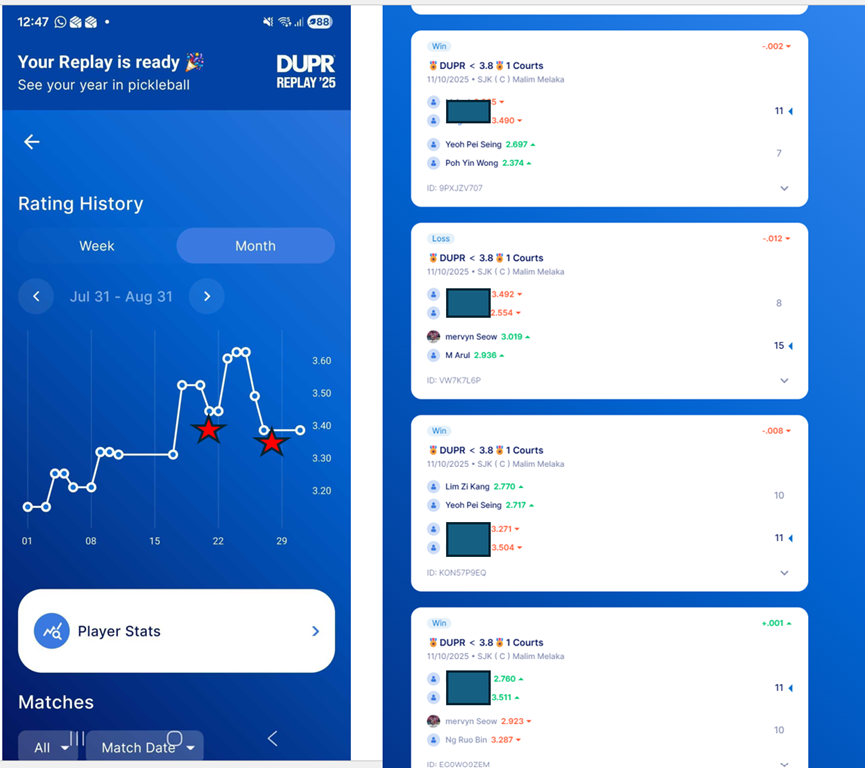
Results show competition play in <3.5 DUPR tournaments with wins and podiums along with prize money, then immediately following the point when her DUPR rose above 3.5, we see a series “social DUPR games” appear on her DUPR profile, played over a single session. During this social session she loses enough games to bring her DUPR down back under 3.5. From our perspective, these losses in the social games appear to be in contrast with her results in official tournament play.
We also see once her DUPR comes down to under 3.5 she then continues competing in under 3.5 category official tournaments. This pattern has occurred more than once in her DUPR history. It does seem that the only time these “social games” appear in her profile is immediately following her DUPR rising above 3.5 and the impact is to bring it back below. This is NOT proof of intentional cheating, but in our view it certainly warrants deeper investigation and we understand why this may be fueling community speculation.
This player has had a podium finish in 13 of the 20 tournaments she has joined so far, with six gold medals, four silver medals, a 107-30 won-loss record overall, and an impressive 78.1% win ratio. She has also earned upwards of RM10,000 from her podium finishes combined.
These screen shots are taken from the players Public DUPR page and demonstrate what we have described above. You can see the point at which the DUPR moves from above 3.5 to below (image on the left) and the Social DUPR games which bring the score down (image on the right).
Example 2 – 21 Year old Male from Selangor
This man plays both mixed and men’s doubles, his name was mentioned in several discussions that PNA conducted with players, tournament officials, and tournament organisers. These discussions raised questions within the community about rating patterns and tournament performance.\
PNA is not alleging that this player has engaged in cheating, misconduct, or intentional manipulation of DUPR ratings. Our review is limited to examining publicly available DUPR data and comparing it with tournament outcomes to determine whether the community speculation surrounding the term “buaya” has any observable basis.
Any observations made here reflect analysis and commentary, not factual conclusions about Player Name’s intentions or integrity.
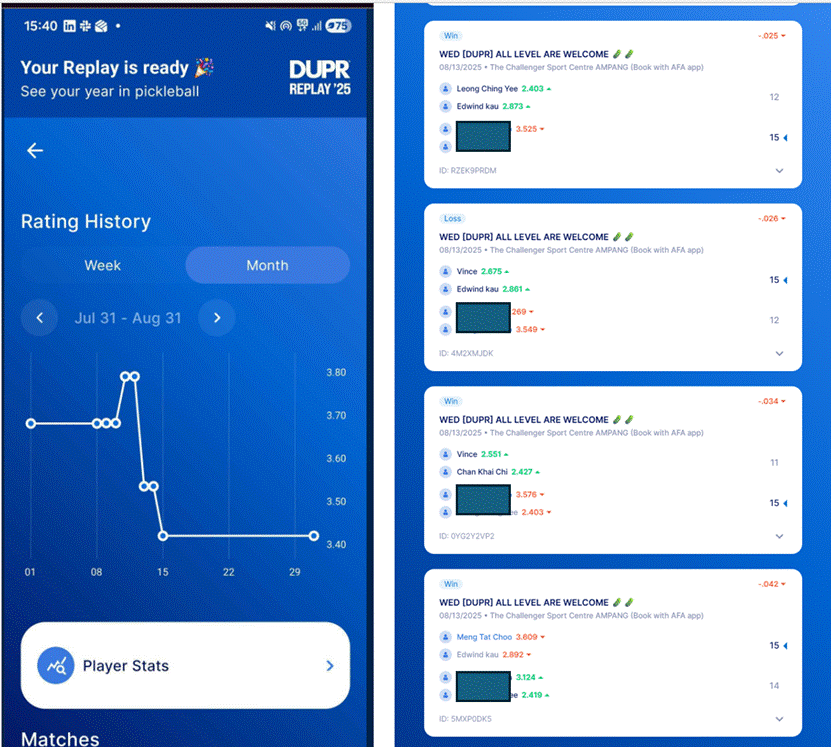
The player’s DUPR rating reached 3.8 on August 11, only for that rating to fall under 3.5 on August 15. Analysis of his DUPR history shows that a two social DUPR session played on the 13th and 15th of August was responsible for the drop we describe above.
Following this drop, he was able to go on a run of Under 3.5 tournaments racking up multiple wins and collecting prize money along the way. From our perspective, these losses in the DUPR social games appear to be in contrast with his results in official tournament play.
These screen shots (below) are taken from the players Public DUPR page and demonstrate what we have described above. You can see the point at which his DUPR moves from above 3.8 to below 3.5 (image on the left) and the a selection of Social DUPR games which bring the score down (image on the right).
In all at the time of writing, we have seen that this player has won at least five gold medals in 15 tournaments, with a won-loss record of 65-16 and a win ratio of 80.2%. WE have been able to identify at least RM7800 in prize money that he has collected.
None of this is proof of intentional cheating. In our view it reflects similar patterns that we observed in the other example’s DUPR history and again we feel that his DUPR history does seem to reflect the community speculation.
Example 3 – 25 Year Old Male from Selangor
This player competes in both mixed and men’s doubles and his name was mentioned in several discussions that PNA conducted with players, tournament officials, and tournament organisers. These discussions raised questions within the community about rating patterns and tournament performance.
PNA is not alleging that this player has engaged in cheating, misconduct, or intentional manipulation of DUPR ratings. Our review is limited to examining publicly available DUPR data and comparing it with tournament outcomes to determine whether the community speculation surrounding the term “buaya” has any observable basis.
Any observations made here reflect analysis and commentary, not factual conclusions about Player Name’s intentions or integrity.
The player has only recently attained a DUPR rating that exceeds 3.5, Looking back in his DUPR history we see that back in July 2025 when his DUPR began an upward trajectory, he played a DUPR social session which significantly reduced his DUPR rating from 3.2 to under 2.9, following which he immediately played in a Novice (under DUPR 3.0) tournament coming 2nd. He then went on to play a series of intermediate tournaments.
These screen shots (below) are taken from the players Public DUPR page and demonstrate what we have described above. You can see the point at which his DUPR moves from above 3.2 to below 2.9 (image on the left) and the a selection of Social DUPR games which bring the score down (image on the right)
At the time of writing, we have identified that in intermediate level tournaments he has won at least 9 gold medals in 16 tournaments, with a won-loss record of 111-22, a win ratio of 83.5%, and we have identified prize earnings of at least RM9,900 that he has collected.
Again the DUPR history is NOT proof that that the player has engaged in cheating or intentional manipulation. But the modus operandi does in our view appear to be similar to the other examples we have showcased.
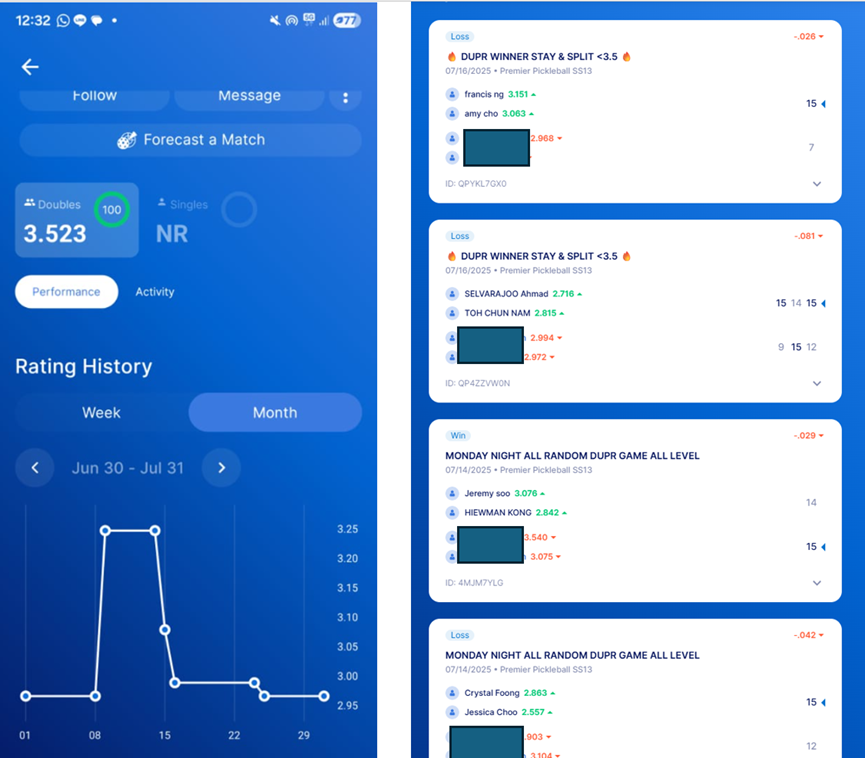
Over this run this player bagged 9 gold medals in 16 tournaments, with a won-loss record of 111-22, a win ratio of 83.5%, and prize earnings of at least RM9,900 thus far.
Irrespective of the three individuals we have highlighted, its generally accepted across the whole Malaysia pickleball tournament playing community that Buayas exist and it’s a large issue that extends to many more players.
Root of the Problem
At its core the Buaya problem is one of individual ethical failure and lack of a moral compass.
The point of Novice and Intermediate competition is to give opportunity and experience to those up-and-coming players who aspire to reach the open ranks and play at the higher level.
Getting a chance to compete against other players who are genuinely at the same level gives those genuine novices and intermediates a chance of tasting some success, building motivation and confidence and building a foundation to eventually compete at the higher level.
The DUPR cheats whom exploit the system in pursuit of coining in on a lucrative side hustle are selfishly undermining the joy, fun and good spirits of the rest of the pickleball community who are in it for the right reasons.
The problem here is that DUPR sandbagging isn’t just a case of gaming the system. It is actually corrosive to the sport. It slowly erodes trust in the competitive ecosystem of pickleball in Malaysia, which is still very much in its growth phase even with all the leaps and bounds it has made over the years. For many amateurs, these events are not just about medals or money, they are milestones, validation of improvement, and motivation to stay in the sport. Sandbagging poisons all of that.
At the grassroots level, its impact is immediate and personal. Legitimate 3.0–3.5 players who repeatedly run into buayas begin to question their own ability. Losses that should be learning experiences instead feel futile. Some stop joining tournaments altogether. Others intentionally underplay themselves just to “survive” in brackets they believe are already compromised. In that sense, sandbagging becomes contagious. Once players believe the system is broken, ethical behaviour feels optional rather than essential.
The issue is also rubbing off onto tournament organisers whom rely heavily—sometimes exclusively—on DUPR numbers and do so without deeper verification, because they lack time and resource to check on every player. But the wider playing community is starting to look to tournament organisesr to do more to combat the issue
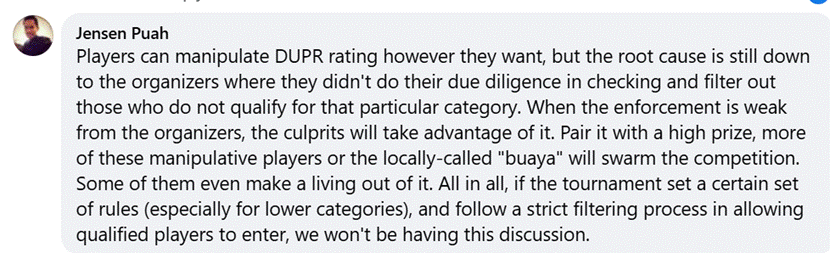
“Players can manipulate DUPR rating however they want, but the root cause is still down to the organisers where they didn’t do their due diligence in checking and filter out those who do not qualify for that particular category,” commented Jensen Puah, a member of the popular Pickleball Malaysia Facebook group established by Edward Chen. “When the enforcement is weak from the organisers, the culprits will take advantage of it. Pair it with a high prize, more of these manipulative players or the locally called ‘buaya’ will swarm the competition. Some of them even make a living out of it. All in all, if the tournament set a certain set of rules (especially for lower categories), and follow a strict filtering process in allowing qualified players to enter, we won’t be having this discussion.”
Then again, being tournament a organizer can be a thankless job—and sandbagging has further complicated things. Several Malaysian tournament organisers, speaking informally, acknowledge that rating-based events have become harder to police, especially with growing prize pools and competition becoming more cutthroat.
Things ultimately circle back to the DUPR, which trumpets itself as the gold standard for pickleball ratings. However, its susceptibility to manipulation is increasingly difficult to ignore. The system struggles to distinguish between genuine inconsistency and strategic losing, especially when “social DUPR games” are treated with the same mathematical weight as competitive matches. In practice, this creates a loophole wide enough to drive a doubles team through. Until DUPR meaningfully differentiates between match contexts or limits how much a rating can drop within short windows, sandbaggers will continue to game the math.
There is also a cultural dimension at play. The casual acceptance of the term “buaya” is telling. What should be an accusation is often delivered jokingly, even admiringly. Winning, after all, is still winning. Prize money is still prize money. In some circles, being “smart enough” to exploit the system is seen less as cheating and more as cleverness. That mindset, left unchecked, normalises deception and shifts blame away from those actively undermining fair competition.
What to Do About Sandbagging: Bag the Buayas?
The question then is this: What can be done?
Like all other problems, solutions exist to counter sandbaggers and kill off these buayas. But these solutions require collective will. Solving this problems ultimately starts with the organisers, who need to start implementing stricter eligibility rules, such as using peak DUPR ratings within a rolling time window rather than current ratings alone. In other words, organisers need to be more vigilant to where transparency is upheld, DUPR ratings are scrutinised, obvious volatility triggers manual review, and repeat offenders are either reclassified or outright banned. from capped divisions.
To this end, some organisers have begun introducing safeguards, such as manual reviews, observable skill assessments, or post-event reclassification. Others are considering hybrid approaches that combine DUPR ratings with organiser discretion.
An example of the foregoing is Pickle Fest 2025. Upon announcing the tournament, the organisers posted a “FAIR PLAY NOTICE” on the event’s official Facebook page that read:
“Recently, we’ve noticed an increasing number of so-called “Buaya” cases appearing in various tournaments—players using multiple DUPR accounts or fake ratings to gain unfair advantages. This kind of behaviour not only damages the spirit of competition but also harms the integrity and growth of our pickleball community.”
It also implemented a zero-tolerance policy for the following while enjoining players to “uphold honesty and sportsmanship” and encouraging them to report cheating:
- Players with multiple DUPR accounts
- False or manipulated ratings
- Any attempt to misrepresent skill levels
Players, too, have a role. Reporting suspicious patterns, refusing to normalise sandbagging behaviour, and supporting stricter rules—even when inconvenient—are all part of protecting the sport. Silence only benefits those exploiting the gray areas.
DUPR could, in theory, do better as well. DUPR was designed to create a fair, transparent system that allows players of similar skill levels to compete against each other. Tournament organisers rely on it to structure divisions, while players use it as a benchmark for improvement and progression. When the system works as intended, it creates competitive balance. When it is exploited, that balance breaks down.
Clearly, some players have figured out how to exploit this system, which appears to be open to manipulation to begin with. The social games, in particular, represent a major loophole that needs correction. Even its new algorithm, which DUPR says is better than before, is exploitable, as players don’t need to lose games anymore because underperforming will do the trick.
“The real issue using DUPR in Malaysia is that its self filling, and this can be manipulated and open to abuse. Players’ dishonestly can increase or lower their scores without any verification by any authority,” observed Ray Yussuf, a pickleball player and member of the Vibrance Pickleball Group.
Then again, making improvements to DUPR is beyond the reach of tournament organisers and pickleball groups everywhere. This is why, in the here and now, it is imperative that they work together with players and other pickleball stakeholders to figure out ways to keep buayas from undermining a growing community that thrives on togetherness even in competition.
Does Malaysia Pickleball Association Have a Role to Play Here?
In our view this is an are that the Malaysia Pickleball Association could help to control, we are not sure of the real reach and boundaries of what MPA is able to do, but investigating “buaya’s” and potentially banning them from MPA approved tournaments for a period of time, with a 2 or 3 strikes leading to permanent ban seems to be something they could look into.
Moving forward, as pickleball in Malaysia continues to grow, the integrity of competition will matter more than ever. Rating systems are tools, not guarantees. Ensuring fair play will depend on how well the community chooses to protect the spirit of the sport alongside its rapid expansion.
Ultimately, sandbagging is not just a technical problem or a statistical quirk. It is an integrity issue. Malaysian pickleball is at a crossroads: it can either grow into a competitive scene grounded in fairness, or slide into one where distrust and cynicism dominate.
Holding the buayas accountable is only the first step. What matters more is whether the system—and the community—has the resolve to drain the swamp in which they are trying to thrive.





As an ICF ACC mindset coach I tend to look at these situations from a performance perspective rather than an emotional one.
Some players seem extremely committed to winning, yet far less committed to discovering how good they actually are.
Real athletes don’t protect their level.
They outgrow it.
Choosing to remain in easier divisions is rarely about strategy. More often, it reflects discomfort with uncertainty, because stepping up means risking losses, ego, and identity. But that exact discomfort is where performance is built.
Winning where you are expected to win is not dominance. It is safety.
And safety has never produced great players.
Everyone talks about “buayas,” frustrations circulate, but mostly in private. Yet silence inevitably lowers the standard of a sporting culture.
A mature competitive environment begins when athletes value growth over easy victories and respect over short-term rewards.
So maybe sandbagging is not just a technical flaw in a rating system.
Maybe it is a mindset choice.
Because playing below your level doesn’t demonstrate superiority.
It simply suggests you are not ready to meet your true potential.
So perhaps the real question is not whether sandbagging exists.
The real question is: what kind of athletes and what kind of community do we want to become?
Medals can be collected. Respect is earned.