Trouble in Paradise? Malaysia Pickleball Association Needs to Get Act Together as Issues on Transparency, Governance Arise


It isn’t a stretch to describe Malaysia’s pickleball scene as the best in Asia—or at least the most robust and most advanced. But some of the gains the country has made to grow the sport might be undone by the controversies now hounding the Malaysia Pickleball Association, the national governing body for pickleball in Malaysia.
Currently, the Malaysia Pickleball Association is facing two major controversies, with one pertaining to governance and the other about transparency. The former, in particular, could be catastrophic to the association as Malaysia’s Sports Commissioner’s Office has already got involved.
Deregistration Looms as Malaysia Pickleball Association Faces Leadership Issue
Back in July, then Malaysia Pickleball Association president Farrell Choo abruptly resigned from his post. It turns out, Choo had already resigned in 2023 but was only convinced to stay, making his resignation unsurprising to some degree. That in itself isn’t the issue here. The problem is that Choo handed over the presidency to Delima Ibrahim, drawing criticism from some quarters, particularly within the Malaysian Pickleball Association.
Delima isn’t the problem either. She is wholly qualified to take the leadership role of the Malaysia Pickleball Association, having been a co-founder of the association and being appointed ambassador of the sport by the International Federation of Pickleball in 2020. The problem is that Delima, at least according to the bylaws of the Malaysia Pickleball Association, should not have been appointed as president in the first place.
Evidently, Deputy President Harmeet Singh should’ve been next in line, not Delima—and that’s the crux of the matter.
“This is not right. According to the constitution, if the president resigns, the deputy should be next in line. Farrell had initially resigned in 2023 but was convinced to return as president,” said Harmeet in a report by Yahoo! Malaysia. “There are several vacancies in the executive committee, and some members were appointed instead of being elected. Because of these discrepancies, I decided to file a complaint with the Sports Commissioner’s Office, which led to the meeting with Mohsinar.”
That meeting between officials of the Malaysia Pickleball Association and Deputy Sports Commissioner Mohsinar Abdul Malek took place on 9 October 2025. Five days later, the deputy commissioner furnished the association with a notice enjoining it to fix this internal squabble by 14 January 2026. Failure to do so, according to the letter, could mean deregistration. Specifically, the Sports Commissioner’s Office is asking the Malaysia Pickleball Association to:
- Allow individuals elected during the 2023 Annual General Meeting to carry out the remedial actions.
- Validate membership in accordance with the Malaysia Pickleball Association constitution and admit state-level pickleball associations as affiliated members.
- Convene an Annual General Meeting and conduct elections for a new main committee.
- Submit to the Sports Commissioner’s Office relevant information report within 30 days after the Annual General Meeting.
- Administer the Malaysian Pickleball Association in accordance with its valid constitution.
Third-Party Trickery and Problems with Transparency
Apart from this leadership conflict, the Malaysia Pickleball Association also has to explain why its official systems are under the control of a third-party external vendor, which could potentially mean there are governance issues within the association and a likely conflict of interest.
The issue has prompted a Change.org petition calling for transparency and accountability in light of this setup. According to the petition, the association’s “official systems are privately controlled by an external vendor with hidden domain ownership, unclear data custody, and possible conflicts of interest” as both websites of the Malaysia Pickleball Association—mpaportal.com and malaysiapickleball.my—are “both developed, owned, and controlled by a private company named Fenix Digital, listed as ‘Official Technical Partner’ and ‘Custodian of all information and data.’”
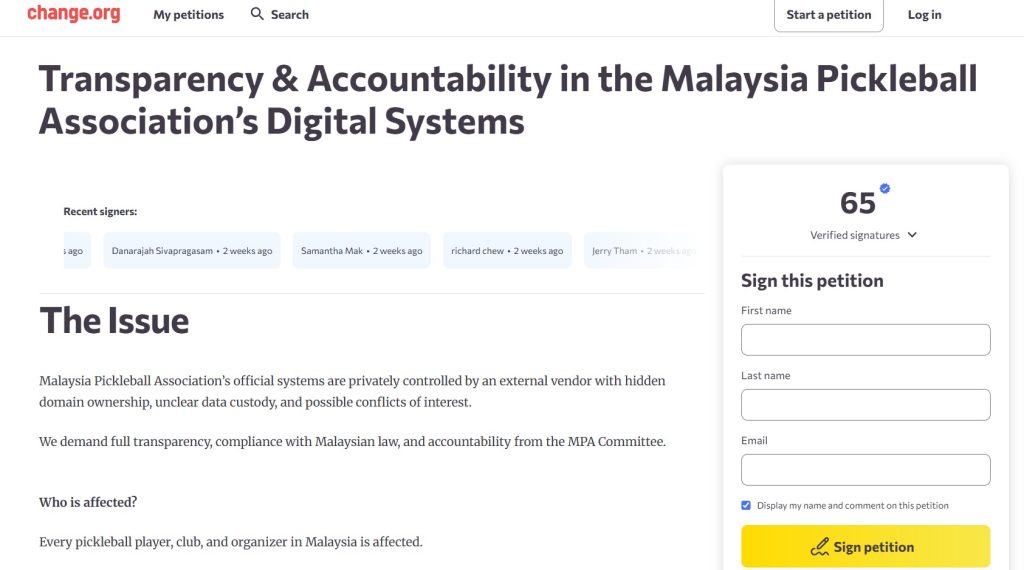
(View the actual Change.org petition yourself HERE.)
According to the same petition, the Malaysia Pickleball Association does not technically own both websites as they are privately registered to Fenix Digital. Thus, should disputes or leadership changes occur, it’s highly likely the association will lose member and tournament data, official communication channels, and branding and digital infrastructure, among others. In other words, should the Malaysia Pickleball Association and Fenix Digital have any sort of falling out, the former could end up without a digital footprint as the latter has control over it.
That’s not to mention the legal ramifications of this setup vis-à-vis Malaysia’s Personal Data Protection Act (PDPA) 2010. Under the law, the Malaysia Pickleball Association, according to the petition, is the “data user legally accountable for how member data is handled,” which means giving Fenix Digital access to this data could make the association liable for data breach, misuse, or loss.
(Watch our very own Andrew Martin discuss this issue in-depth in Episode 8 of the Nasty Nelson PNA Podcast. You can also watch it in YouTube by clicking HERE. Don’t forget to LIKE the podcast and SUBSCRIBE to it!)
A Ruling Elite Overwhelming the Association?
These two major issues coalesce into one important question: Who really makes the decisions within the Malaysia Pickleball Association? In the case of the leadership change, it appears Choo made it unilaterally—and, evidently, without regard for the association’s bylaws. As for choosing Fenix Digital, the process seems more complicated but nonetheless has the hallmarks of ruling-class decision-making, where the decision was made by a select few only and likely with little to no regard for the group’s constitution.
These are all speculations, of course. But the bottom line is that the Malaysia Pickleball Association is in hot water, and it threatens to undermine the inroads the country has made in establishing itself as quite possibly the sport’s next frontier—especially here in Asia.
If it is any consolation, the Malaysia Pickleball Association has time to fix all these problems.
(PNA reached out on several occasions to MPA for comment and to get their side of these issues; however, we never received any response.)