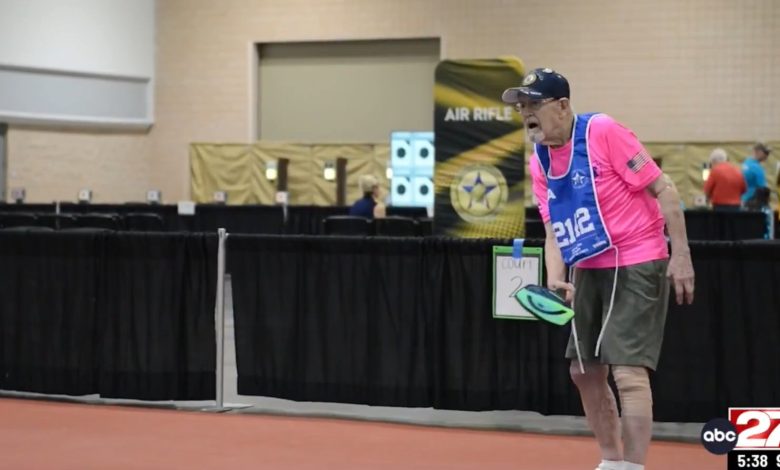
Rafael Kozlusky is 90 years old. He is competing in a multi-sport event in Tampa. And he would like everyone to know that pickleball is the reason he is still going strong.
The Lebanon, Pennsylvania native is one of the oldest participants at this year’s Golden Age Games in Tampa, Florida—the United States Department of Veterans Affairs’ annual celebration of veteran athleticism that has been running since 1985. Kozlusky, a former US Navy radio operator who served for eight years, is competing in doubles pickleball alongside partner Richard Olwig of St Louis—who, at 89, is the younger half of their partnership.
Together, they are among the most compelling arguments for what pickleball does for people of advancing age. The sport, which combines elements of tennis, badminton, and table tennis on a compact court with a perforated ball and solid paddles, has become something of a phenomenon among older players precisely because it delivers genuine physical engagement without the brutal physical demands of full-court racket sports. The shorter distances, the slower ball speed relative to tennis, and the social nature of doubles play make it extraordinarily well-suited to players who want to stay active without risking injury.
Kozlusky would endorse all of that—and then add some.
“Any veteran at any age, I would encourage them to play pickleball,” he said. “It keeps you healthy, it keeps you moving, and it’s enjoyable.”
That is not simply the enthusiasm of a new convert. Kozlusky has been competing in multiple disciplines at the Golden Age Games, including billiards, shuffleboard, and air pistol. He is not a man defined by a single sport. But pickleball, it seems, has a special place in his routine.
The Golden Age Games themselves are worth understanding in context. Founded by the VA in 1985, the event is open to veterans aged 55 and above and covers a broad range of sports and competitive activities designed to promote health, camaraderie, and the kind of purpose-driven engagement that retired veterans often find difficult to maintain. Pickleball has become one of the event’s most popular disciplines in recent years, reflecting the sport’s broader explosion in popularity among the over-50 demographic across the United States and, increasingly, across Asia and Europe.
What makes Kozlusky’s participation particularly moving is not just his age—remarkable as that is—but the perspective it gives him on the other competitors around him. Asked about the Golden Age Games, he did not talk about winning. He talked about the veterans who showed up despite carrying burdens that make Kozlusky’s own participation look effortless by comparison.
“It’s great to see all of the veterans here,” he said. “And the ones I respect most are some of the veterans with no limbs—a lot of the veterans are in wheelchairs, a lot of the veterans have post-traumatic stress syndrome. So those are the ones I respect, and they’re still here trying.”
It is a reminder that the Golden Age Games are about far more than competition. They are about what happens when sport becomes a vehicle for rehabilitation, connection, and the assertion that service-related injury, disability, or trauma does not have the final word on what a person can do and experience. Pickleball, with its low barrier to entry and high social reward, fits that mission particularly well. It can be played from a wheelchair. It can be learned in a single session. It can be enjoyed without a significant prior athletic background.
Rafael Kozlusky served his country for eight years. He is now 90 years old, competing in four events at a national veteran games, urging anyone who will listen to pick up a paddle.
The sport could not have a better ambassador.