Jack Wong Hong-kit’s Winning Streak by the Numbers: Why Leapmotor Singapore Open Is His to Lose

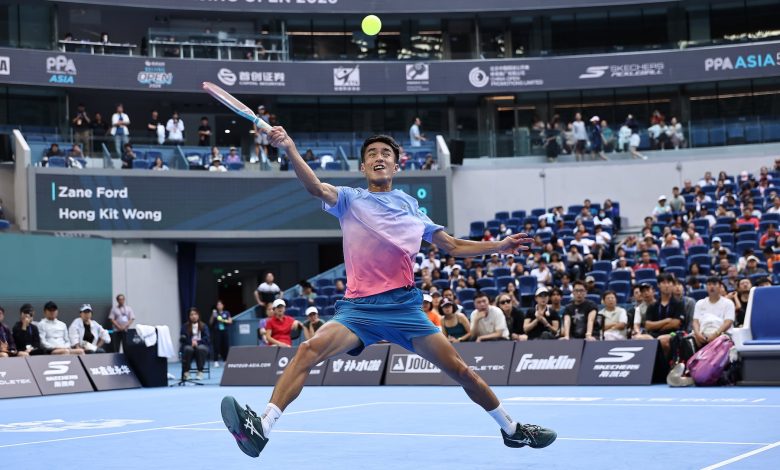
Jack Wong Hong-kit arrives at the Leapmotor Singapore Open 2026 as the man everyone is chasing. Two straight PPA Tour Asia Men’s Singles titles. A serving game that has been getting progressively more ruthless. And a statistical trend that points in one direction.
The question is not whether Hong-kit is the favourite. He clearly is. The question is whether anyone in the Singapore draw has figured out how to stop him.
The Stat That Matters
In singles side-out scoring, only the server can score. That means the cleanest measure of a player’s dominance on serve is points per side out—the number of points won while holding serve, divided by the total number of serving turns. Sustained scoring runs push it up. Giving the serve back cheaply drags it down. The higher the number, the more difficult the server is to play against.
Hong-kit’s three most recent deep runs tell a clear story. He posted a PPS of 1.30 at the Macao Open in May, finishing with silver. He won the Beijing Open in June with a PPS of 1.22. Then in the Sansan Tokyo Open, he was at his most suffocating: 89 points from just 56 serving turns for a PPS of 1.59—and he won the tournament without dropping a single game.
The number is going up. He is peaking at exactly the right time.
The Finals Tell the Real Story
Where the data gets most interesting is in the championship matches specifically. Hong-kit’s final-round PPS across his three most recent deep runs reads: 0.72 in Macao, 1.16 in Beijing, 1.69 in Tokyo. That is a straight line upward—from a serve that got neutralised when the trophy was on the line, to one that slammed the door.
In the Macao final, he served 25 times and scored just 18 points. Tama Shimabukuro shut him down and won 11-9, 11-9. Two months later in Tokyo, Wong was averaging nearly a point and a half every single time he served in the final. He won comprehensively.
The trajectory is not subtle.
Macao Was a Warning, Not a Weakness
The silver at Macao should not be misread as a slump. Round for round, Wong was arguably serving at his best level of any tournament throughout that week—right up until the final.
His Macao semifinal produced a PPS of 2.20, the single best serving round across all three of those tournaments. Then Shimabukuro arrived in the final and did to Wong precisely what Wong had done to everyone else all week—neutralised the serve at the critical moment. The gap between silver and gold at the Macao Open was not about talent. It was about one player holding his level for one more match when another could not.
The Blueprint to Beat Him
If the Singapore draw has a strategy, it has a name: do a Tama.
In the Macao final, Shimabukuro did not try to out-serve Wong. He dragged the match into a side-out slog where neither player scored cleanly, 57% of all serving turns produced zero points, and the longest consecutive scoring run by either player was just three. Shimabukuro’s own PPS was a quiet 0.85—and that was entirely the point. Neutralise the runs, win the ugly match, and Wong’s primary weapon disappears.
Take that away in Singapore, and the three-peat is in genuine trouble.
But Wong arrives in the Lion City in the best serving form of his year, riding back-to-back titles, with a finals trend pointing only upward. He has learned—across Macao, Beijing, and Tokyo—how to maintain his level when the match is on the line. The evolution has been visible and measurable.
Three consecutive Men’s Singles golds on PPA Tour Asia is not hype. On the evidence of what Wong has produced across these last three tournaments, it is the favourite’s line.
Small island. Big stage. The Hong Kong, China star who has finally learned how to finish is ready to do it again.