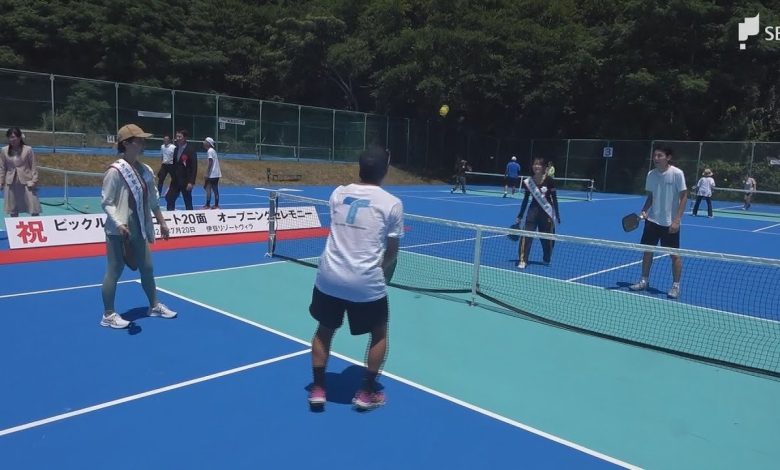
Japan has just raised the bar for pickleball in Asia.
In Higashiizu, Shizuoka Prefecture, a sprawling new complex has opened its doors with 20 courts ready for play, all bookable by reservation. The town is making no secret of its ambition—it wants to be seen as a hub for the sport, a place where enthusiasts and professionals alike can gather.
The launch was marked with a proper ceremony: ribbon-cutting, demonstrations from seasoned players, and even a chance for visitors to pick up a paddle themselves. Yasushi Miyazaki, representing Izu Bio Park, spoke of the centre as a future “sacred destination” for pickleball. It’s a bold statement, but one that reflects the confidence behind the project.
“We will work to make this a sacred destination for pickleball in the future,” he said.
For those unfamiliar, pickleball is a curious blend of tennis, badminton, and table tennis. Played with solid paddles and a perforated plastic ball, it’s slower than tennis, which makes rallies easier to sustain. The court is compact—just 20 feet wide and 44 feet long, the same size as a badminton doubles court—with a slightly lower net. Doubles is the more common format, and the rules include quirks such as the “two-bounce rule” and the infamous “kitchen,” a non-volley zone that keeps play balanced.
The sport’s origins trace back to 1965 in Washington state, where Joel Pritchard, Bill Bell, and Barney McCallum improvised a family game that has since grown into a global phenomenon. From its early reputation as a pastime for older players, pickleball has evolved into a competitive sport with professional tours, team leagues, and international tournaments. The Professional Pickleball Association Tour and Major League Pickleball now headline the calendar, while the Pickleball World Cup draws national teams from across the globe.
Asia has been catching up quickly. Facilities and clubs have sprung up in countries from India to South Korea, and Japan’s new centre is another sign of the sport’s momentum. With twenty courts at Izu Resort Villa, Higashiizu is positioning itself not just as a recreational venue but as a potential stage for larger competitions.
It’s a significant step. Pickleball may not yet be an Olympic sport, but with this kind of investment and enthusiasm, its presence in Asia is only set to grow. And for Higashiizu, the hope is clear: to become the beating heart of pickleball in Japan.