Pampanga’s Picklers in PH Build Own Directory to Bring Together Players, Courts, and More in One Place

Numbers alone rarely tell the full story of a sporting boom, but the Philippines’ certainly makes a strong opening case. A 1,213 percent increase in DUPR users over the past year puts the country comfortably atop the list of the world’s fastest-growing pickleball markets, dwarfing even Indonesia’s already substantial 405 percent climb into second place. Nothing else on that list comes remotely close. It’s the kind of figure that stops reading like steady growth and starts looking like a genuine explosion.
What tends to get lost in a statistic that large, though, is why it’s happening in the first place. Pickleball’s appeal was never really about the sport in isolation. It’s about what happens around the net just as much as what happens over it—the easy conversations between rallies, the mixed-skill matches that let a beginner share a court with someone considerably better, the sense that turning up alone doesn’t actually mean playing alone. That social pull, more than the sport’s low barrier to entry or its gentle learning curve, is arguably what’s turning casual curiosity into the kind of sustained, community-driven growth the Philippines is currently posting.
Pampanga Pickleball Community Directory Is Proof of Concept
If you want to see that community instinct in action rather than simply take it on faith, Pampanga’s pickleball scene offers about as clean an example as exists anywhere in the country. Local players there have put together the Pampanga Pickleball Community Directory, a single hub bringing together every court, club, open-play session, coach, tournament, store, and service across the province. It is the sort of infrastructure that usually takes an official federation years to assemble, built instead by the community that actually plays there and in just about a year give or take.
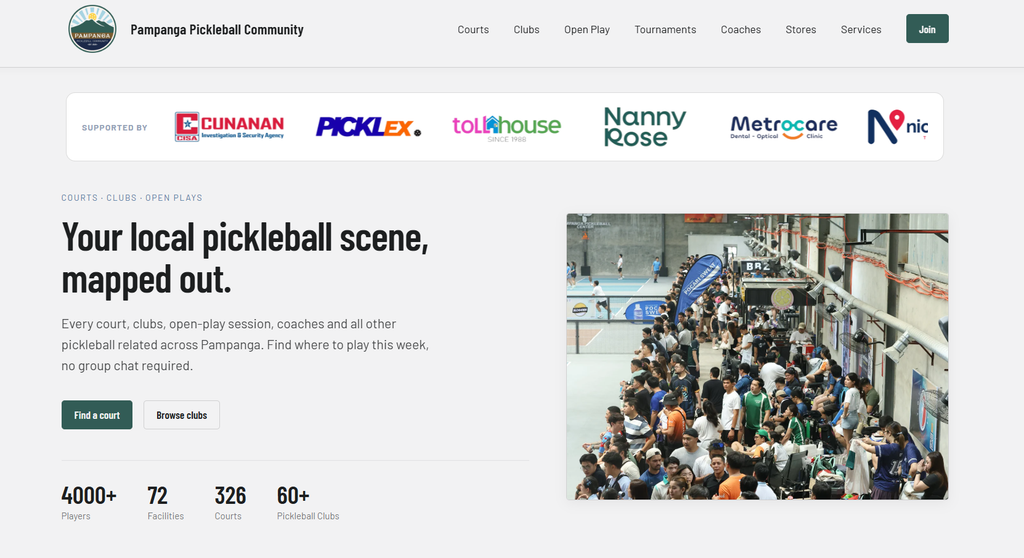
The scale behind it is genuinely striking for a provincial initiative. The directory currently tracks more than 4,000 players, 72 facilities, 326 courts, and upwards of 60 active clubs, spanning towns from Angeles City and San Fernando to Mabalacat, Magalang, and Mexico. Scroll through it and the picture that emerges isn’t a handful of enthusiasts keeping a spreadsheet—it’s dozens of clubs, each with its own name, its own organisers, and its own regular open-play sessions, all now sitting under one shared roof rather than scattered across a dozen different group chats.
That’s really the quiet genius of a project like this. A newcomer in San Fernando can find a Tuesday night open play through SIDE-OUT, a beginner in Mabalacat can book a coach through Pickleball Reserve, and a club in Magalang can list its own sessions without needing to build a following from scratch first. The directory doesn’t create the community. It simply makes an already sprawling one visible to itself—which, for a sport growing this fast, might matter just as much as court space or coaching quality.
It’s also drawn genuine backing beyond the players themselves, with local businesses like Toll House, MetroCare, and Courtside Essentials PH signing on as sponsors, and even non-profit angles built in—one upcoming tournament in September, Pickle for Sight, is being run specifically to benefit ophthalmology patients.
None of this happens without the social pull that got people onto the courts in the first place. Pampanga’s directory isn’t really a technology story or an infrastructure story, not at its core. It’s what community-building looks like once enough people fall for the same game at the same time—and given the Philippines’ growth rate, Pampanga is unlikely to be the last province where that happens.
Check out the Pampanga Pickleball Community Directory.