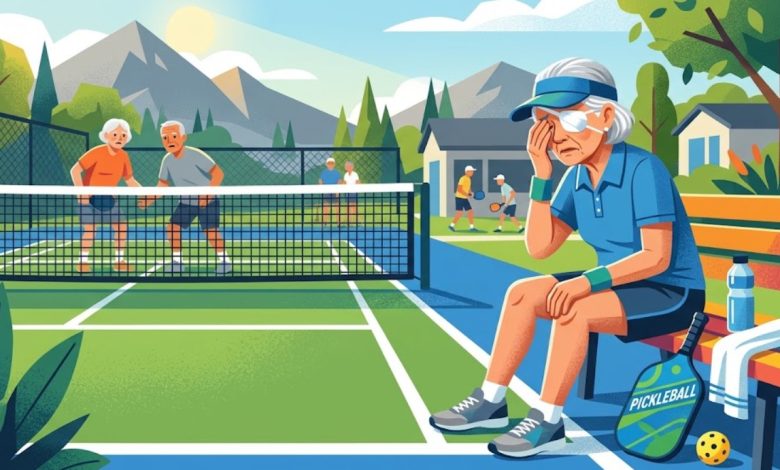
Pickleball has a reputation as the friendly sport: slow ball, small court, easy to learn. But as more players across Asia pick up a paddle, doctors are noticing a less friendly side effect. Eye injuries are turning up in hospitals, and the people most at risk are the ones the sport often attracts the most: older players.
When the Ball Meets the Eye
At Khoo Teck Puat Hospital in Singapore, doctors have treated patients with eye injuries from pickleball, particularly from the ball hitting the eye directly. Yeo Tun Hang, head of ophthalmology and visual sciences at NHG Eye Institute at the hospital, described two such cases. In one, a patient developed retinal breaks and needed laser treatment to lower the risk of retinal detachment. In another, a previously implanted intraocular lens was dislocated, requiring surgery to refix it.
Other hospitals have seen similar cases. The Singapore National Eye Centre (SNEC) has attended to a corneal abrasion linked to the sport, while a player at the National University Hospital was diagnosed with iritis, an inflammation of the iris and surrounding tissue, and microhyphema, a mild form of eye bleeding.
Singapore’s hospitals don’t keep pickleball-specific registries, so Yeo says it’s not possible to reliably tell whether such injuries have risen in recent years.
Datuk Aaron Aziz’s Painful Reminder
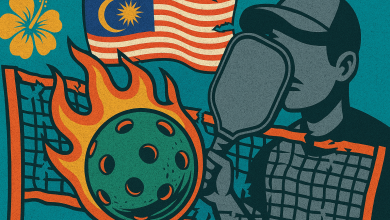
It isn’t only Singapore. Back in March, Malaysian actor Datuk Aaron Aziz was hit in the left eye by a ball during a game, an incident we covered at the time. He shared the aftermath in a video update, saying it was hard to open his eye and that it was very swollen. The injury led to his hospitalisation and forced him to miss a scheduled fan meeting.
His case showed how quickly a routine game can take a turn, even for a celebrity. And it fits a larger pattern.
What the Numbers Say
For hard data, there’s the United States, where an estimated 20 million people play. A study in the peer-reviewed journal JAMA Ophthalmology, published in October 2025, used a nationally representative sample of pickleball eye injuries seen in emergency departments. The researchers estimated that these injuries rose by about 400 incidents a year, from fewer than 200 in 2021 to 1,262 in 2024.
Almost half of them (43 percent) came from direct impact by the ball, and players over 50 were 39 percent more likely to suffer such injuries than younger players.
Why Pickleball, and Why Older Players?
The ball isn’t as fast as in other racket sports, but experts say lightweight paddles can send it flying at up to 60 km/h. And speed, says John Komar of Nanyang Technological University’s National Institute of Education, is only part of the story.
“Players in pickleball are very often very close to the opponents,” he said, compared with tennis, where players rarely face each other at the net. Because reaction time can’t be compressed, he noted, players simply have no time to avoid the ball.
Swarup Mukherjee, also of the National Institute of Education, points to the sport’s player profile. The majority of players, he said, are in their fifties or sixties, an age when reflexes naturally slow. The smaller court also means the ball covers less distance in less time, raising the risk of hitting a player’s body.
He also offers a note of balance. The number of injuries is rising, he says, not because the risk is increasing but because more people are playing. The real question is the rate of injury per player over a given time on court. And he stresses that pickleball offers real health benefits, from lower demands on the heart and lungs to better reaction time, balance and control, which can matter especially for people in their fifties and sixties.
What Players Can Do
Marcus Ang, who heads the corneal and external eye disease and refractive surgery departments at SNEC, has two pieces of advice:
- Protect your eyes. Senior players in particular should be aware of the risk of eye injury in any racket sport, and wear protective eyewear when necessary.
- Don’t wait it out. After any eye injury, seek emergency consultation at an emergency department with eye specialist care. Some injuries, such as microscopic hyphema, may produce only mild symptoms at first but can lead to complications if ignored.
None of this means players should hang up their paddles. It does mean that goggles, long treated as optional on recreational courts, are worth a place in the bag, and that a ball to the face should never be brushed off.