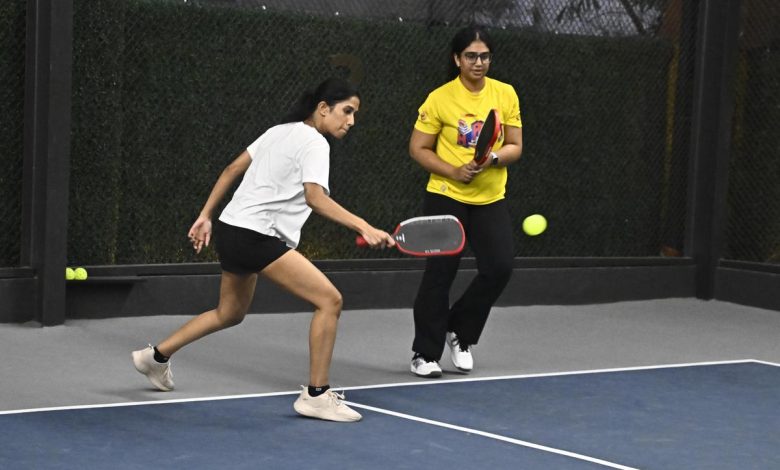
By five o’clock on any given weekday evening, the courts at Hyderabad Paddle Park are rarely quiet. The rhythm sets in quickly—plastic balls snapping across nets, paddles rising and falling, players rotating in tight cycles of waiting and playing. The city has found its new sport, and it is not letting go.
Pickleball’s rise in Hyderabad has followed a pattern now familiar across Asia: social media clips sparking curiosity, corporate outings converting the curious into regulars, and regulars gradually becoming something closer to obsessives. What began as a casual social experiment has taken root across the city’s neighbourhoods, from Jubilee Hills to Madhapur to Gandipet, with courts multiplying to meet demand that shows no sign of levelling off.
“Earlier there were only eight to ten courts in the city,” says Dorlodhu Pradeep, a part-time coach at Hyderabad Paddle Park. “Now you can find courts in different localities.”
Pickleball Here, There, Everywhere
The geography of Hyderabad’s pickleball scene has its own character. Jubilee Hills has emerged as the sport’s spiritual home, with Hyderabad Paddle Park and The Kitchen drawing steady evening crowds from across the city. Madhapur’s Ayyappa Society houses Pickle Yard, which has become the preferred destination for IT professionals—a natural fit given the area’s concentration of tech workers looking for something to do after long desk-bound days. Gandipet’s Cross Court Sports offers a larger campus environment for those who want more than a single court booking. Dink N Dash and the Pullela Gopichand Academy round out the city’s growing network of venues.
Most have moved indoors—a practical response to Hyderabad’s formidable heat as much as to rising demand. Air conditioning has pushed the sport into a premium bracket, with top venues charging between ₹1,500 and ₹1,600 per hour. Smaller facilities come in closer to ₹700. Equipment adds another layer of cost, with entry-level paddles starting at ₹1,500 to ₹2,000 and high-end carbon fibre options climbing considerably higher. Kannur Gopi, a regular at The Kitchen who has progressed from casual player to competitive tournament participant in under a year, estimates he has spent up to ₹40,000 across court bookings, equipment, and associated costs. His carbon fibre paddles—priced at around ₹6,000 each—need replacing every three to four months.
“Most other sports are cheaper,” he admits. “But once you start, it is hard to stop.”
Harder Than It Seems and the Learning Curve
That addictive quality is consistently the first thing experienced players mention—and it is inseparable from the sport’s most distinctive feature: the gap between how it looks and how it feels.
Darla Jyotirmayi, a finance professional from Nanakramguda who makes the commute to Jubilee Hills regularly, describes a first impression shared by many. “We kept seeing it online and finally decided to try it. Though it seemed simple at first, we discovered it wasn’t.” Garikapati Madhavi, an engineer from Kukatpally trying the sport for the first time, identified the specific trap that catches most newcomers. “Online videos never show how hard it is to judge the bounce. You think you know where it will go, and then you miss it completely.”
That disconnect between expectation and reality has, paradoxically, become one of the sport’s growth drivers. Players who discover the gap come back to close it. And closing it takes weeks, not sessions.
Gaurav Jha, a digital marketer from Ayyappa Society who found his way to pickleball during a corporate outing, is a representative case. “My boss explained the rules and I just joined.” It took him five to six matches before he felt genuinely comfortable. Chandravela Yash, a competitive tennis player who travels 30 to 50 minutes from KPHB to play at The Kitchen, adapted faster than most—but even he is measured about the assumptions tennis experience allows. “Tennis helped me adjust,” he says. “But the dink is the hardest shot and consistency matters.”
The learning curve has its own physical demands. Indoor balls behave differently from outdoor ones—lighter and slower—and neither behaves intuitively for beginners. Wrist control is an early stumbling block. Court shoes are recommended over running shoes because of the constant lateral movement involved. And warm-ups, according to Pradeep, are non-negotiable—a lesson too many players learn the hard way.
“Most injuries happen when players skip warm-ups,” he says. “People only take it seriously after they get hurt.”
Rising Popularity
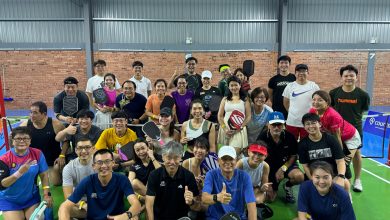
The crowd filling Hyderabad’s courts on any given evening reflects the sport’s unusually broad appeal. Corporate teams trying it for the first time. IT professionals arriving straight from work. Teenagers with tennis backgrounds playing with competitive intensity. The social element is central—a standard session is split among four players, which both reduces individual cost and creates the kind of rotating group dynamic that builds community almost by accident.
Pickleball arrived in Hyderabad through short-form video and corporate curiosity. It is staying because the game, once you get past the deceptive simplicity of it, is genuinely difficult to walk away from.
The courts are filling up. The paddles are wearing out. The city has found its sport.