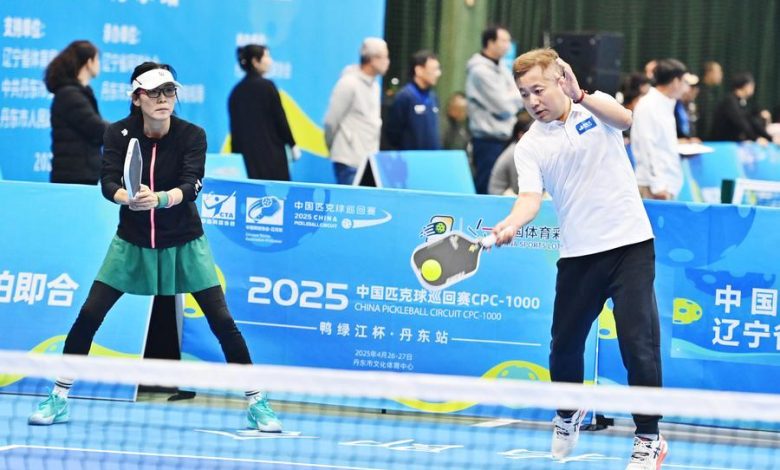
When the 2026 China National Pickleball Championships unfolded in Hebi, Henan Province, earlier this September, more than 30 teams from across the country gathered to compete. For a sport that only began to take root in China a few years ago, the scale of participation spoke volumes.
Pickleball in China, simply put, has moved far beyond its niche beginnings. Preliminary figures show that this year alone, 10 provincial-level regions—including Henan, Guangxi, and Beijing—have added pickleball as a mass-participation event. The China Pickleball Circuit, launched in 2024 with just over 80 stops, now boasts 1,000 venues nationwide.
According to Bai Xilin, director of the Tennis Administration Center of China’s General Administration of Sport, “There are currently eight million people in China who regularly participate in pickleball, and about 20 million who have tried it. The number of active pickleball players in China may reach 30 million in the future.”
Hebi: A City Transformed
Hebi has become the sport’s unlikely epicentre. By 2025, the city had built 1,600 courts, creating one of the densest pickleball networks in China. The sound of paddles striking balls now echoes daily along the Qi River, where residents gather for morning play.
Local resident Zhang Shaohua, who first picked up the sport in 2024, has since established a players’ community and built her own venue. “In Hebi, pickleball started as a trend, but it has become a daily routine,” she said.
City leaders see pickleball as more than recreation. Zhao Hongyu, secretary of the CPC Hebi Municipal Committee, explained: “Hebi has a solid industrial foundation and rich cultural and tourism resources, but its urban visibility and influence still need to be enhanced. We urgently need to build a highly recognisable city brand that can connect with both domestic and international markets.”
Hebi’s industrial base has been quick to adapt. Leveraging its coal chemical, rubber, and plastics industries, the city has built a pickleball supply chain from raw materials to high-end equipment.
At Henan Geli Sports Goods Co., Ltd., machines churn out paddles, nets, and flooring. General manager Xing Weimin noted: “We export pickleball-related products to Europe, the Americas, and Southeast Asia. Recently, customers have come to the factory almost every day to discuss business. The pickleball market has huge potential.” Sales exceeded 25 million yuan in 2025 and are projected to double in 2026.
A Sport Spreading Across China
Other cities are embracing pickleball in creative ways. Hangzhou converted space beneath an elevated highway into a 6,000-square-metre pickleball park. Beijing’s Fengtai District repurposed a basketball arena into a pickleball club that now hosts the Beijing Pickleball Super League. Suzhou opened a 23-court complex, while Nanjing built courts on the 51st floor of a shopping mall, offering panoramic views alongside play.
Hosting tournaments has become a way to blend sport, culture, and commerce. Song Hongfei of Viva Goods Co., Ltd. believes pickleball could become “the next marathon-like popular sport.” The China Sporting Goods Federation reported that the domestic market for pickleball equipment and services exceeded 1.8 billion yuan in 2025, with a projected compound annual growth rate of 47 percent over the next five years.
Pickleball’s appeal lies in what Bai Xilin calls the “three lows and three highs.” Low barrier to entry, low cost, and low risk make it accessible to all ages. High social value, high overall benefits, and high safety ratings make it sustainable.
Internationally, pickleball continues to surge. In the United States, it has been the fastest-growing sport for five consecutive years. In Southeast Asia, countries like Vietnam and the Philippines have embraced it widely. Hebi itself has hosted international events, including the 2025 Hebi Invitational, which welcomed players from 14 countries.
Earlier this year, American students and teachers visited Hebi, pairing with local teenagers for friendly matches and cultural exchanges. They played pickleball, toured historic sites, and even tried traditional crafts.
A Sport With Staying Power
Pickleball in China is no longer a passing fad. It is reshaping cities, industries, and communities, while forging international connections. Hebi may have led the charge, but the sport’s momentum is now nationwide. And with millions already playing, pickleball looks set to become one of China’s defining recreational movements of the decade.