
You’ve seen the numbers on profiles, tournament brackets, and social media. But what does a 4.0 DUPR actually say about a player? A recent post by DUPR and The Dink Pickleball offers a clearer picture, and the answer might surprise you.
First, What Is DUPR?
DUPR (Dynamic Universal Pickleball Rating) is a rating system built from real match results. Ratings run on a scale from 2.000 to 8.000, with separate ratings for singles and doubles. Its stated aim is to help players find competitive matches at their level and give organisers a fair standard for events. The company says more than two million players are on the platform.
Where Does a 4.0 Rank?
According to the data shared, here’s how the percentiles break down:
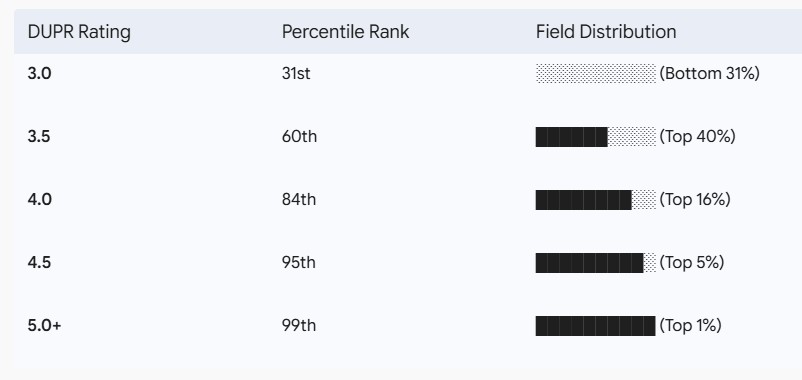
In plain terms, a 4.0 player is ahead of roughly 84 out of every 100 rated players. At 4.5, you’re ahead of about 95. And at 5.0, you’re in the top one per cent.
Most Players Are Closer to the Middle
The post also looks at where players actually sit, and it challenges the idea that most regulars play at an advanced level:
- 2.0 to 2.49: 11 per cent
- 2.5 to 2.99: 20 per cent
- 3.0 to 3.49: 29 per cent (the largest group)
- 3.5 to 3.99: 24 per cent
- 4.0 to 4.49: 11 per cent
- 4.5 to 4.99: 4 per cent
- 5.0 and above: 1 per cent
Add up the middle two brackets, and 53 per cent of rated players have a rating somewhere in the 3s. The numbers thin out quickly after that. Only 16 per cent are rated 4.0 or higher.
Why It Matters
If you’ve ever felt outmatched at a local tournament or while scrolling through clips of strong players, these numbers offer some perspective. A 4.0 won’t automatically make you a threat in elite-level events, but it does put you well above most of the rated population. DUPR itself pointed out that a rating above 4.0 is worth celebrating, since around 99 out of every 100 players sit below 5.0.
A Few Caveats
Two things are worth keeping in mind. First, these figures cover rated players only, meaning those who have logged matches in DUPR. Casual players who’ve never submitted a result aren’t included, so the data may not reflect everyone who picks up a paddle. Second, the figures come from a single post by DUPR and The Dink Pickleball, not a full published study, so treat them as a guide, not gospel.
Indeed, the takeaway is simple: a rating is a measure, not a verdict. Whether you’re a 3.0 or a 4.5, the number is there to help you find the right match, and a good one is more fun than a lopsided one.